
REVIEW · OBSERVATORY VISITS
Mount John Observatory Stargazing Experience, Tekapo
At 1,029 metres above Lake Tekapo, this experience takes you into the heart of the Aoraki Mackenzie International Dark Sky Reserve, where the Milky Way can look startlingly close. You begin in town, then ride up to the University of Canterbury’s Mount John Observatory for a focused night under the Southern Hemisphere sky.
I like the mix of simple naked-eye stargazing and serious telescope viewing. I also like that the guides make the Southern Cross, planets, star clusters, and even the idea of distant galaxies understandable to beginners. The main drawback is weather: clouds can cancel the summit visit, and an indoor replacement may feel disappointing if you came for a true night outside.
Key points at a glance
- Mount John summit access: Reach the 1,029-metre observatory site by return transport from Lake Tekapo.
- Southern Hemisphere highlights: Learn to identify the Southern Cross, the true southern star, planets, constellations, and star clusters.
- Three telescope viewing opportunities: The experience uses advanced observatory equipment as well as unaided viewing.
- Small scheduled groups: Trips are limited to a maximum of 22 people per departure time, with an overall activity limit of 30.
- Cold-weather planning: Extreme-weather coats are supplied, but you should still wear warm layers, even in spring.
- Weather matters: Poor conditions can lead to a different date, a full refund, or an indoor alternative.
Why Mount John is the right place for stargazing
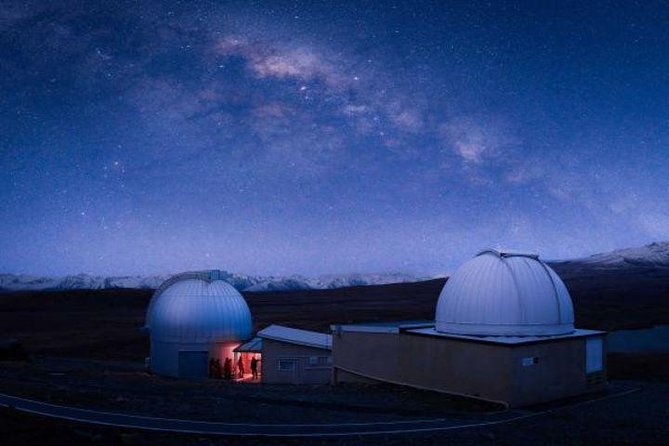
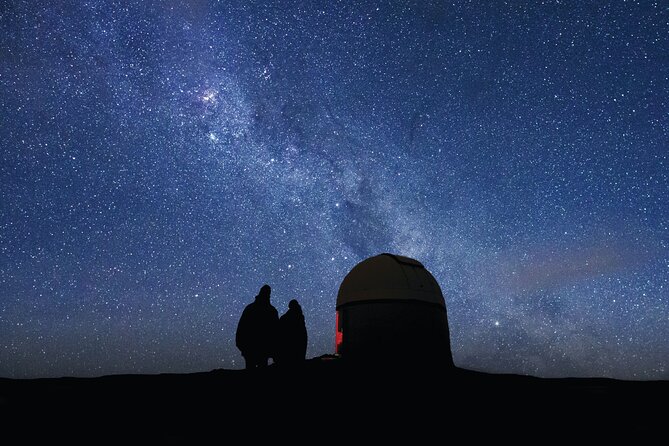
Lake Tekapo sits inside the Aoraki Mackenzie International Dark Sky Reserve, the largest Gold standard reserve in the world. That designation matters because artificial light is restricted across a wide area, giving the observatory a much darker setting than most town-based stargazing spots.
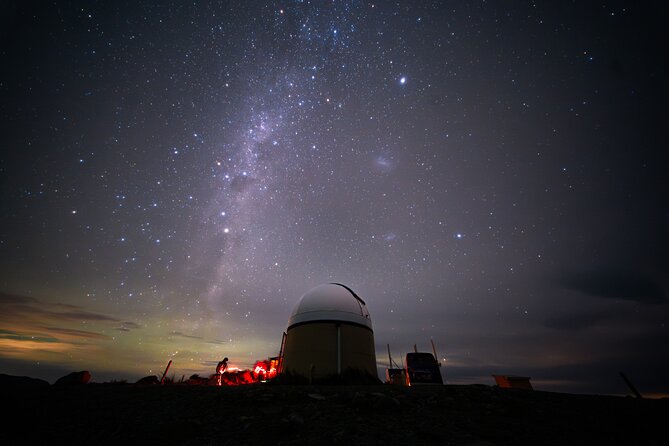
The reward is not just a sky full of stars. You may see the Milky Way as a broad band rather than a faint smudge. Depending on the night, the guide may point out planets, star clusters, solar systems, and distant galaxies. The exact view changes with the season, moonlight, cloud, and visibility, so no two visits are quite alike.
The observatory also gives the experience a useful edge. You are not simply standing in a field with a guide and a laser pointer. You are visiting a working astronomical research centre connected with the University of Canterbury. That setting adds context, especially if you want to understand how professional astronomy differs from casual stargazing.
More Observatory Visits in the world:
- Royal Observatory Greenwich & Prime Meridian Entrance Ticket
★ 4.5 · 1,095 reviews - Griffith Observatory Hike: Guided Tour through Griffith Park
★ 5.0 · 1,020 reviews - Tenerife: Mount Teide Observatory Guided Tour
★ 4.6 · 818 reviews
Starting at the Dark Sky Project in Lake Tekapo
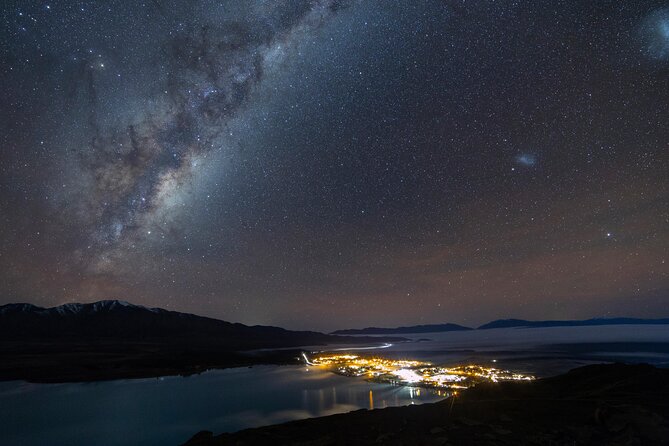
Your evening begins at the Dark Sky Project base in Lake Tekapo. Allow time to check in with the team before the vehicle leaves for Mount John. Return transport from the township is included, so you do not need to arrange your own way up the mountain.
The ride takes you from the lakeside settlement to the summit at 1,029 metres. The transfer is short compared with the main activity, listed at about 15 minutes, but it removes a practical worry. You can concentrate on the sky rather than driving an unfamiliar mountain road at night.
Hotel pickup and drop-off are not included. If you are staying outside the township, plan your own route to the meeting point and back. This is easy to overlook when booking, particularly if you have arranged accommodation in a wider part of the Mackenzie Basin.
Ninety minutes at the University of Canterbury observatory
The main session lasts about 1 hour and 30 minutes. With the transport and check-in period, the full experience runs for roughly 1 hour and 45 minutes.
At the summit, the guide combines three elements. First comes naked-eye viewing, often supported by laser pointers. This is where you learn the shape of Southern Hemisphere constellations and get oriented before looking through equipment. The Southern Cross is a likely highlight, and the guides can also explain the difference between the true southern star and the nearby false pointer that can confuse first-time observers.
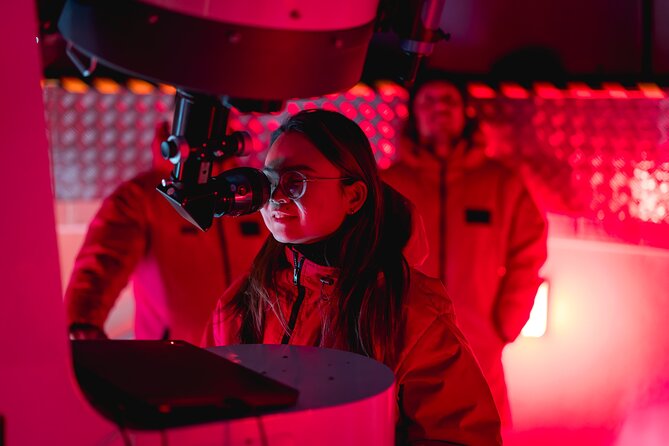
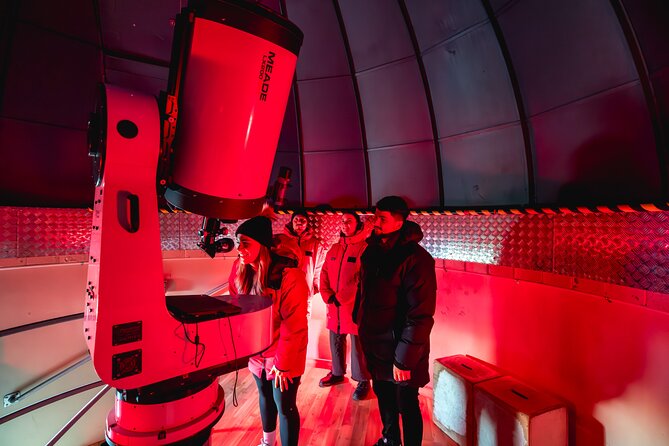
Next comes telescope viewing. Advanced observatory equipment lets you examine objects that would otherwise remain points of light. Previous sessions have included views of Jupiter’s moons, star clusters, and other astronomical objects. The precise list depends on what is visible that night, so you should treat examples as possibilities rather than promises.
Finally, the guide connects the sights to the wider story of the sky. That matters if you do not already know the names of stars or constellations. The session is designed for people with only a passing interest, not just committed amateur astronomers.
The strongest part: clear explanations for beginners
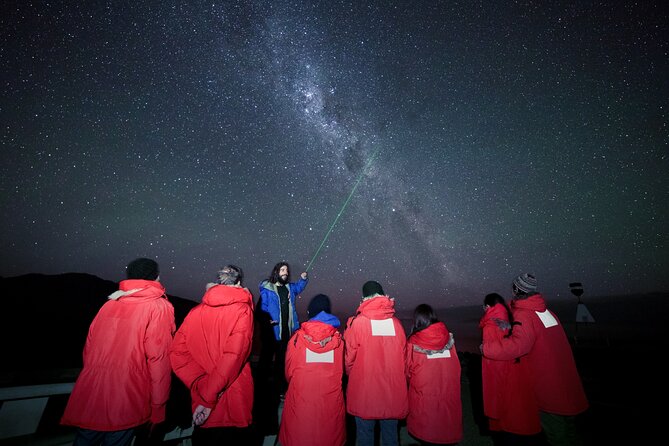
The guides are the heart of this experience. The best sessions make complicated subjects feel manageable without turning the evening into a lecture. You learn what you are looking at, how to find it again, and why it matters.
Guides may include Kieran, Alice, or Olive, names associated with particularly warm and engaging sessions. The guide team can provide the tour in English or Mandarin. Your chosen tour language is important for safety, since you must be able to understand the language used during the activity.
You do not need to arrive with a working knowledge of astronomy. The session begins with familiar points in the sky and builds from there. If you already know a fair amount, the observatory setting and telescope access can still make the visit worthwhile, though the pace is aimed at a broad audience rather than specialist observers.
A useful feature is the willingness to work around patchy clouds. If gaps open in the cover, the guide may shift the order of the presentation and show what is available. One cloudy evening can still offer glimpses of stars and constellations, but a fully covered sky remains a serious problem.
More Stargazing Tours in the world:
- Dubai Red Dunes ATV, Camels, Stargazing & 5* BBQ Al Khayma Camp
★ 5.0 · 21,620 reviews - Sharm El-Sheikh: Ultimate ATV Quad, Stargazing & BBQ Dinner
★ 4.7 · 4,084 reviews - Tenerife: Teide National Park Sunset & Stargazing Tour
★ 4.2 · 3,812 reviews - Tenerife: Sunset and Stargazing at Teide National Park
★ 4.7 · 2,826 reviews
Cold, darkness, and the practical side of the summit
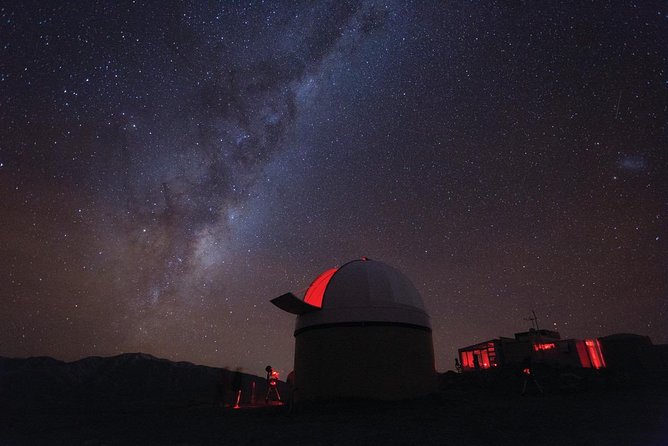
Mountaintop stargazing is cold. It can feel that way even during November and spring, when daytime temperatures around Tekapo seem mild. The operator provides extreme-weather coats, which are a real help, but I would still wear several warm layers, covered shoes, and something for your hands and head.
The summit is also very dark by design. That is excellent for astronomy but less helpful when you are walking. White torches and phone lights can interfere with other people’s night vision and with the viewing conditions, so stay near the guide and group.
This is not the best choice if you have significant mobility issues. The experience takes place at a mountain observatory in darkness, and the activity information specifically warns that it is not recommended for people with mobility limitations. Children can take part, but they must be accompanied by an adult.
The scheduled group limit is a maximum of 22 people per trip time, while the activity information also lists a maximum of 30 participants. Either way, this is not a private viewing. You may need to share telescope time and listen from behind other people, especially during the most popular departures.
Cloud cover can change the whole evening
The biggest uncertainty is not the guide or the telescope. It is the weather.
The experience requires suitable conditions. If poor weather forces cancellation, you can be offered another date or a full refund. You should keep some flexibility in your Tekapo plans if seeing the stars is a priority. Several nights in the area give you a better chance of going up than a single fixed evening.
An indoor alternative may be offered when clouds prevent the summit session. This can be useful if you want to learn about astronomy despite the weather, but it is not equal to being outside under a dark sky. If the forecast is poor and your schedule is tight, confirm what replacement is available before accepting it.
Even a partial cloud cover does not always ruin the outing. The guide may show stars through openings and use the clearer parts of the sky. Still, do not book this expecting guaranteed Milky Way views. Astronomy depends on conditions you cannot control.
The moon also affects the mood of the night. A bright moon can wash out faint stars and reduce the impact of the Milky Way, even when there are no clouds. If you can choose your date, a darker moon phase may give you a stronger view of faint objects.
Is the $139.39 price good value?
At $139.39 per person, this is not a casual after-dinner walk. You are paying for return transport to the summit, an expert-led session, access to the observatory site, telescope viewing, and a location inside one of the world’s major dark-sky reserves.
The value is strongest if you want structure. You could look at the night sky on your own for free, but you would miss the explanation, telescope access, and help finding Southern Hemisphere sights. The experience also saves you from planning how to reach the summit and how to view the sky safely in the dark.
The value is weaker if you are mainly seeking photographs. This is an observation-focused activity, not a dedicated astrophotography session. One session found that even a small amount of wind prevented staff from taking photographs with personal cameras. Bring your phone or camera if you like, but book for the viewing and teaching rather than guaranteed pictures.
The price also feels easier to justify if you have limited astronomy experience. A guide can turn a mass of stars into a readable map. If you are already an experienced observer with your own equipment, you may find the group format less flexible than an independent night outside.
English, Mandarin, and group comfort
English and Mandarin guiding are available. You need to speak the language of the tour for health and safety reasons. If you cannot do that, you will not be allowed to join, so check the language choice carefully before booking.
The group size is moderate rather than intimate. You will have several other people around you, particularly during telescope viewing. The advantage is that the shared format keeps the price below a private observatory visit and gives the guide enough people to create a lively session.
The disadvantage is that telescope time may require patience. If you want long, quiet periods at an eyepiece, ask whether a private or specialist option exists. This particular experience is built around a guided introduction to the Southern Sky.
How to prepare for a better night
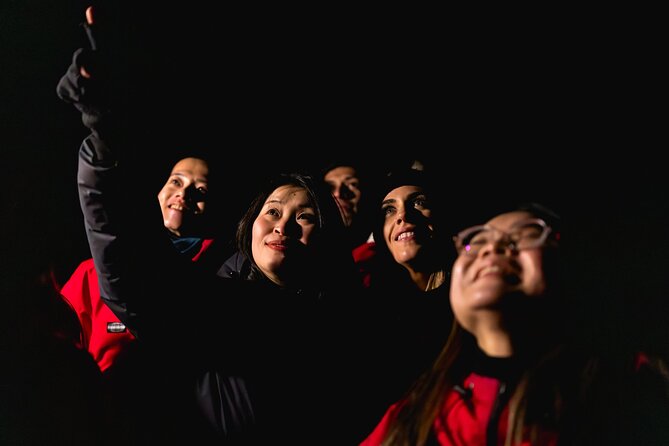
A few simple choices can make a large difference:
- Wear warm layers even if the afternoon in Tekapo feels comfortable.
- Use covered, stable footwear because the summit is dark and walking can be awkward.
- Stay close to the guide once the lights are reduced.
- Avoid bringing a bright white torch. Preserve your night vision and that of the group.
- Keep your plans flexible if the forecast is unsettled.
- If you book a departure after midnight, double-check the date. The booking date can be easy to misread.
- Eat beforehand. Meals and snacks are not included.
- Keep expectations realistic about photographs. The sky is the main event.
The supplied cold-weather jacket helps, but it does not replace sensible clothing. I would also avoid scheduling a tight connection immediately afterward. Weather decisions and mountain transport can make an evening less predictable than the advertised 1 hour and 45 minutes.
Who will enjoy this experience most?
This is a strong match for first-time stargazers, families with older children, couples looking for a memorable evening, and anyone who wants to see the Southern Hemisphere sky with guidance. You do not need to know the difference between a star cluster and a galaxy before arriving.
It also suits people who value place. The experience is not just about looking up. You are taken to a high observatory site linked with the University of Canterbury and surrounded by the dark skies of the Mackenzie region.
It is less suitable for someone who dislikes cold, cannot stand comfortably in a dark outdoor setting, or needs guaranteed clear skies. It may also disappoint dedicated astrophotographers who want complete control over equipment, timing, and camera setup.
Should you book the Mount John stargazing experience?
Book it if you have a free evening in Tekapo and the night sky is part of your reason for visiting. The combination of summit access, expert guidance, dark-sky conditions, and powerful telescopes gives beginners a clear way into astronomy. The Southern Cross, Jupiter’s moons, star clusters, and the Milky Way can become far more memorable when someone shows you exactly where to look.
Before paying, check the forecast, plan for serious cold, and accept that clouds may lead to a rescheduled date or an indoor session. If you can keep one extra evening available, this is one of the better ways to give the night sky a fair chance.
FAQ
How long does the Mount John Observatory experience last?
The experience lasts approximately 1 hour and 45 minutes, including check-in, transport, and the summit session. About 1 hour and 30 minutes is spent stargazing at Mount John.
Where does the tour begin?
You check in with the Dark Sky Project team in Lake Tekapo township. Return transport to the Mount John summit is included.
How high is Mount John Observatory?
The summit is 1,029 metres above Lake Tekapo.
Is transport included?
Return transport from Tekapo township to the summit is included. Hotel pickup and drop-off are not included.
What can I see through the telescopes?
Depending on the conditions and what is visible, you might see planets, moons, star clusters, solar systems, and distant galaxies. Jupiter’s moons have been included among the possible sights.
Is the experience suitable for children?
Children can participate, but they must be accompanied by an adult.
Are warm clothes provided?
Extreme cold-weather jackets are provided. You should still wear warm layers because the summit can be very cold, including during spring.
What happens if the weather is poor?
The experience may be moved to another date or canceled with a full refund. An indoor alternative may also be offered.
Can I cancel for a full refund?
You can cancel at least 24 hours before the scheduled start time for a full refund. Cancellations or changes made less than 24 hours before the start are not refunded or accepted.
Fresh listings near the world
- Cabo de Gata: Guided Night Walk with Stargazing★ 4.7 · 36 reviews
- Brisbane: Glow Worms, Sunset, Star Gazing & BBQ★ 4.4 · 26 reviews
- Cabo de Gata: Stargazing Experience★ 4.5 · 7 reviews
- Antofagasta: Astronomical Tour with a Guide★ 3.7 · 4 reviews
- Boulder: Guided Astronomy Tour★ 4.7 · 11 reviews
- 1-Day Grand Canyon Tour from Las Vegas: Stargazing & Sunrise★ 3.6 · 3 reviews
- Astronomical Tour: San Pedro de Atacama – Chile★ 4.5 · 3 reviews
- Perth: Pinnacles Stargazing, Sandboarding & Beach Kangaroos★ 5.0 · 3 reviews
Observatory Visits, side by side.
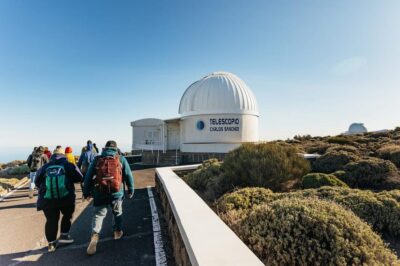
Royal Observatory Greenwich & Prime Meridian Entrance Ticket
Read our review →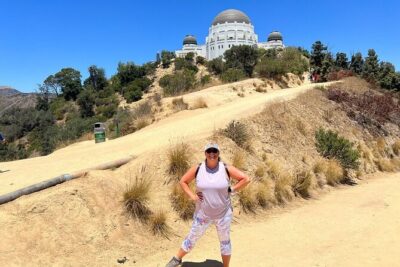
Griffith Observatory Hike: Guided Tour through Griffith Park
Read our review →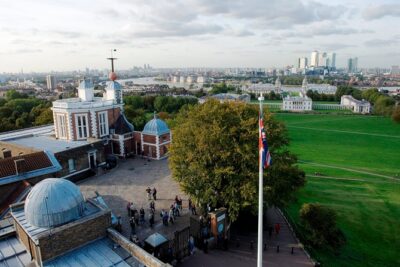
Royal Observatory Greenwich & Prime Meridian Entry Ticket London
Read our review →
Private Getty Center to Griffith Observatory Guided Tour
Read our review →
Lists this night appears in