
REVIEW · OBSERVATORY VISITS
Royal Observatory Greenwich & Prime Meridian Entry Ticket London
Standing with one foot in the eastern hemisphere and one in the western hemisphere is the fun, memorable centerpiece of this visit. Inside the Royal Observatory Greenwich, you follow the story of time, longitude, and astronomy through old rooms, clocks, instruments, and an audio guide.
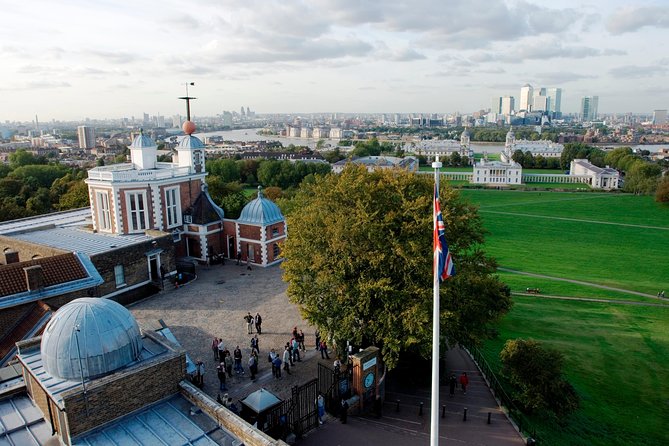
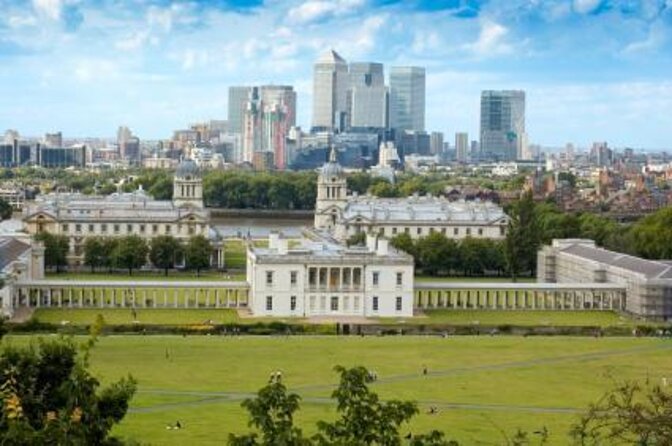
I like the Prime Meridian photo opportunity and the striking view over London from Greenwich Park. I also like the chance to see Harrison’s clocks and the Octagon Room, a fine Christopher Wren interior. The main drawback is the steep hill and stairs, which can make the visit difficult for anyone with limited mobility.
Key points to know
- Stand on the Prime Meridian: Take your classic east and west photo in the Meridian Courtyard.
- See Harrison’s famous clocks: Learn how accurate timekeeping helped ships calculate longitude.
- Look inside Flamsteed House: Visit the former home of the Astronomers Royal and Wren’s Octagon Room.
- Allow more than two hours if possible: The observatory itself takes about two hours, but Greenwich offers several nearby sights.
- Expect a steep walk uphill: The views improve as you climb, but this is not an effortless arrival.
- Use the audio guide: A free guide adds useful context about time, space, and the observatory’s scientists.
What You Are Really Visiting at Greenwich
The Royal Observatory is not mainly a planetarium or a modern space museum. It is a historic working site where astronomers helped solve practical problems of navigation and timekeeping.
That distinction matters. If you expect large space exhibits or a full planetarium program, you may find the visit more limited than expected. The focus here is on the development of accurate time, the measurement of longitude, and the scientists and instruments connected with Greenwich.
You will see the Prime Meridian line, but the best part of the visit is the story behind it. Greenwich Mean Time became a global reference because of work carried out here, and the observatory helped shape the way the modern world organizes time zones and navigation.
The attraction is also part of Maritime Greenwich, a UNESCO World Heritage Site. That gives you more to do after the observatory, including the free National Maritime Museum and Queen’s House, plus the Cutty Sark nearby.
More Observatory Visits in the world:
- Royal Observatory Greenwich & Prime Meridian Entrance Ticket
★ 4.5 · 1,095 reviews - Griffith Observatory Hike: Guided Tour through Griffith Park
★ 5.0 · 1,020 reviews - Tenerife: Mount Teide Observatory Guided Tour
★ 4.6 · 818 reviews
Reaching the Observatory Hill
The Royal Observatory sits on a hill inside Greenwich Royal Park. You can approach through the park, and the walk gives you broad views toward the River Thames, the City of London, and the skyline beyond.
The hill is the first practical issue to consider. Several people find the climb steeper and longer than expected, especially when walking from the river or the Cutty Sark area. You may also encounter stairs near the entrance and inside the historic buildings.
For a fit visitor, the uphill walk is part of the setting and rewards you with a fine view. If you have knee, balance, or mobility concerns, contact the attraction before booking. Certain sections are not fully accessible, and the historic layout includes stairs with limited lift access.
Plan your route before arriving. Public transport serves Greenwich, but the final approach to the observatory still involves getting up the hill. The site is near public transportation, yet finding a pickup point for a car can be awkward. If you are using a taxi or rideshare, do not assume it can take you directly to the entrance.
The Meridian Courtyard and the Classic Photo
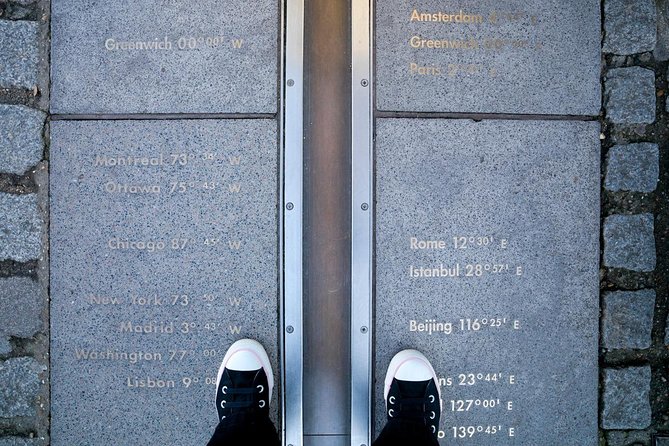
Your visit begins in the Meridian Courtyard, where a marked line identifies the Prime Meridian. This is the longitude line traditionally used as the starting point for measuring east and west around the globe.
The popular photograph shows you straddling the line with one foot in each hemisphere. It is a simple idea, but it gives the visit an immediate sense of place. You are not just looking at a display about longitude. You are physically standing at the location associated with Greenwich Mean Time.
The courtyard can become crowded, especially soon after opening. If the photo matters to you, go there early in your visit rather than leaving it until the end. You can take the picture first, then return to the exhibits without worrying about missing the moment.
Keep your expectations sensible. The line itself is not a vast monument. Its value comes from the history attached to it and the amusing visual proof that you have placed yourself in two hemispheres at once.
Flamsteed House and the Astronomers Royal
From the courtyard, the visit continues through Flamsteed House. This was the home and workplace of the Astronomers Royal, who observed the sky and worked to improve astronomical measurements.
The building helps you understand the observatory as a place of patient, careful work. Before satellite navigation and digital clocks, astronomers relied on observations, calculations, pendulums, and mechanical instruments. Small improvements could have major effects on ships crossing oceans.
The audio guide is useful here because the rooms and objects may not explain themselves fully. You can download a free audio guide, with information provided in multiple languages. The supplied details refer to seven languages for the guide available at the observatory and ten languages for the downloadable version, so check the current arrangement when you arrive.
This is a self-guided visit rather than a standard guided tour with one guide leading a fixed group. At times, staff or volunteers may explain displays and answer questions. A guide named Ross has received particular praise for making the subject engaging, but you should not assume a specific guide will be working during your visit.
More Entry Tickets in the world:
- Miami: Frost Museum of Science and Planetarium Entry Ticket
★ 4.5 · 429 reviews - Houston Museum of Natural Sciences: Planetarium Ticket
★ 4.5 · 139 reviews - Jasper: Jasper Planetarium and Telescope Combo Tour Tickets
★ 3.8 · 118 reviews - London: Royal Observatory Planetarium Show Entry Ticket
★ 3.9 · 89 reviews
The Octagon Room, Designed by Christopher Wren
The Octagon Room is one of the most attractive spaces at the observatory. Sir Christopher Wren designed it, and it remains one of the best-preserved Wren interiors in London.
The room gives you a strong sense of the observatory’s age and purpose. Look up and around rather than rushing through. This is not simply an old room added for decoration. It was part of a place built to observe the sky and record measurements with care.
The room is also a useful reminder that Greenwich is as much an architectural and historical visit as a science visit. If you enjoy old buildings, design, and the practical side of scientific work, you may spend more time here than you expect.
Harrison’s Clocks and the Problem of Longitude

The clocks are likely to be the highlight if you enjoy engineering and practical history. John Harrison developed highly accurate marine timekeepers, solving one of the major navigation problems of the age.
A ship could determine its position north or south by observing the sun and stars. Working out east or west longitude was much harder. Accurate time allowed sailors to compare local solar time with a fixed reference time and calculate their position at sea.
The displays help explain why this was not an abstract scientific puzzle. Better timekeeping could reduce navigational errors and make long ocean voyages safer. Harrison’s clocks show how a precise mechanical invention changed the way people crossed the world.
Give these exhibits time. It is easy to spend more than a few minutes taking photographs, but the story is the real reason to look closely. The audio guide adds useful explanations, and the displays are especially rewarding if you want more than a quick Prime Meridian picture.
The Shepherd Gate Clock and Greenwich Mean Time
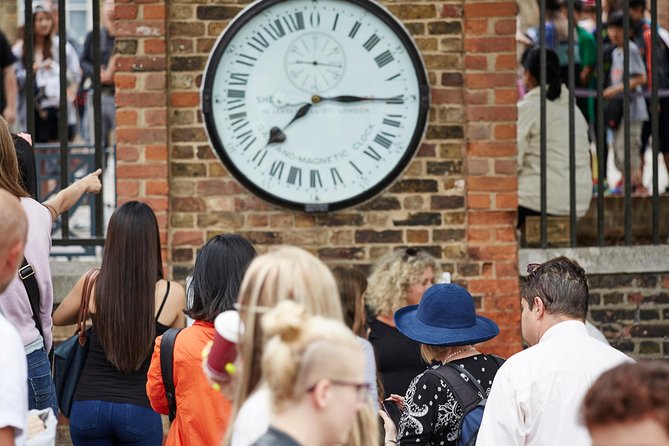
Outside Flamsteed House, the Shepherd Gate Clock has a special place in the story of public time. It was the first clock to show Greenwich Mean Time to the public.
That detail connects the observatory to everyday life. Timekeeping was not confined to astronomers and sailors. Public clocks helped spread a shared time standard, which became increasingly important as railways, commerce, and communication connected distant places.
The bright red Time Ball on Flamsteed House is another practical piece of history. First used in 1833, it still operates today. It provided a visible time signal, allowing people nearby to set their clocks accurately.
These details give the observatory more character than a simple museum of old instruments. You see how time moved from private scientific measurement into public life.
The Great Equatorial Telescope
The Great Equatorial Telescope sits inside the large onion-shaped dome, one of the most recognizable features of the observatory.
The telescope gave astronomers new views of the universe more than a century ago. Even if you are not an astronomy enthusiast, the scale of the instrument and the unusual dome make this a memorable stop.
The telescope also changes the pace of the visit. The clocks and rooms focus on measurement and navigation, while the telescope points toward the larger questions of stars, planets, and the universe. You get a compact story of astronomy, from precise timekeeping on Earth to observation of distant space.
Do not expect a modern observatory visit with lots of active viewing equipment. This is a historic instrument and exhibition experience. Its value is in seeing the technology that once expanded the known universe.
The Scientists Behind the Story

The observatory is linked with many important scientists and inventors, including Harrison, Isaac Newton, Edmond Halley, James Bradley, Annie Maunder, George Airy, and Albert Einstein.
You do not need to arrive with a background in astronomy. The audio guide and displays give you a route through the main ideas. Still, the experience rewards curiosity. If you enjoy understanding how discoveries were made, you will get more from the visit than someone who only wants a photograph on the Meridian line.
The range of names can also make the visit feel dense. You may find some displays more technical than others. Give priority to the clocks, Time Ball, telescope, and rooms if your time is short.
How Long to Allow and What to Add Nearby
The stated visit takes about two hours, which is a fair estimate for the observatory itself. That gives you time for the Meridian Courtyard, Flamsteed House, the Octagon Room, the clocks, the Shepherd Gate Clock, the Time Ball, and the Great Equatorial Telescope.
I would not treat Greenwich as a quick stop squeezed between central London attractions. The nearby National Maritime Museum and Queen’s House are free to visit and within walking distance. The Cutty Sark, the surviving tea clipper, is another major attraction nearby and now operates as a museum and visitor experience.
Greenwich Park also gives you room to pause after the indoor exhibits. You can look back toward London, rest after the hill, and decide how much more you want to see.
If you only have two hours in the area, the observatory is possible. If you can spare most of a day, the visit makes much better sense. You will not need to pay another admission fee for the National Maritime Museum or Queen’s House, which improves the value of the trip.
Is the $33.90 Ticket Good Value?
At about $33.90 per person, the ticket is reasonable if you care about the Prime Meridian and the observatory’s historic instruments. It includes admission, fees, and access to the free audio guide.
The value is less clear if you only want to see a line on the ground. The displays and buildings provide the substance, so plan to spend time with Harrison’s clocks, the historical rooms, and the telescope.
Advance booking can help you secure entry to a popular attraction, particularly during busy periods. However, there have been reported problems with some mobile vouchers and barcode scanners, including visitors needing to buy replacement tickets at the box office. One issue involved a voucher that could not be scanned, and another involved an iPhone app problem.
Bring your confirmation and make sure you can display the ticket before reaching the entrance. If the mobile ticket does not load, speak with staff right away and keep proof of any additional purchase. This is a practical reason to check the booking details carefully rather than waiting until you are standing at the gate.
Who Will Enjoy This Visit Most?
This experience suits families, couples, solo visitors, and anyone interested in clocks, navigation, astronomy, or London history. Children may enjoy the two-hemisphere photograph, while older visitors may appreciate the story of time and longitude.
It is also a good choice for anyone who wants a London visit with a clear sense of place. The combination of park views, old buildings, scientific instruments, and nearby maritime attractions gives you more variety than the ticket description might suggest.
You may be disappointed if you expect a planetarium, a large modern space center, or a fully guided tour. The experience is mainly self-guided, and the attraction is compact. Visitors with limited mobility should also plan carefully because of the hill, steps, and access limits in the historic buildings.
Children under four enter free, and children must be accompanied by an adult. Service animals are allowed.
Should You Book the Royal Observatory Greenwich?
Book this experience if standing on the Prime Meridian has real appeal to you and you want the historical explanation behind Greenwich Mean Time. The clocks, Time Ball, Octagon Room, and Great Equatorial Telescope give the visit enough substance to justify the admission price.
I would book ahead during a busy London visit, but I would also prepare for possible mobile-ticket trouble by checking the barcode before leaving your hotel. Arrive early if you want a clear Meridian photo, and allow extra time for the uphill walk.
If you are already planning Greenwich, the observatory fits neatly with the free National Maritime Museum, Queen’s House, Greenwich Park, and Cutty Sark. If you only have time for a quick photograph and do not enjoy museums, buying at the entrance may be the simpler choice.
You can cancel for a full refund up to 24 hours before the experience start time. Changes or cancellations made less than 24 hours ahead are not accepted for a refund.
FAQ
How long does the Royal Observatory visit take?
The visit takes approximately two hours. You should allow longer if you also plan to visit Greenwich Park, the National Maritime Museum, Queen’s House, or the Cutty Sark.
What can I see at the Royal Observatory?
You can see the Prime Meridian line, Flamsteed House, the Octagon Room, Harrison’s clocks, the Shepherd Gate Clock, the Time Ball, and the Great Equatorial Telescope.
Is an audio guide included?
Yes. A free downloadable audio guide is included. The available information refers to several language options, including seven languages onsite and ten languages for the download.
Is transportation included?
No. Transportation to and from the attraction is not included. The observatory is near public transportation, but you still need to walk uphill to reach it.
Are children under four admitted free?
Yes. Children under four enter free, and children must be accompanied by an adult.
Is the observatory accessible for wheelchair users?
Certain parts of the attraction are not fully accessible. The historic buildings include stairs and limited lift access, so contact the attraction before visiting if you need assistance planning your route.
Can I cancel the ticket for a refund?
Yes. You can cancel up to 24 hours before the experience start time for a full refund. Cancellations or changes made less than 24 hours before the start time are not accepted.
Fresh listings near the world
- Cabo de Gata: Guided Night Walk with Stargazing★ 4.7 · 36 reviews
- Brisbane: Glow Worms, Sunset, Star Gazing & BBQ★ 4.4 · 26 reviews
- Cabo de Gata: Stargazing Experience★ 4.5 · 7 reviews
- Antofagasta: Astronomical Tour with a Guide★ 3.7 · 4 reviews
- Boulder: Guided Astronomy Tour★ 4.7 · 11 reviews
- 1-Day Grand Canyon Tour from Las Vegas: Stargazing & Sunrise★ 3.6 · 3 reviews
- Astronomical Tour: San Pedro de Atacama – Chile★ 4.5 · 3 reviews
- Perth: Pinnacles Stargazing, Sandboarding & Beach Kangaroos★ 5.0 · 3 reviews
Observatory Visits, side by side.

Royal Observatory Greenwich & Prime Meridian Entrance Ticket
Read our review →
Griffith Observatory Hike: Guided Tour through Griffith Park
Read our review →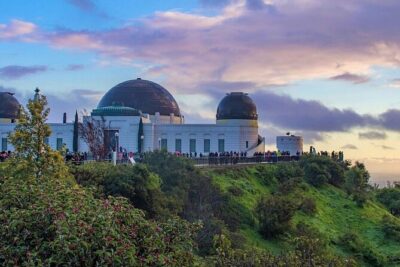


Private Getty Center to Griffith Observatory Guided Tour
Read our review →
Mount John Observatory Stargazing Experience, Tekapo
Read our review →
Lists this night appears in