
REVIEW · SEDONA STARGAZING
The Night Sky Star Story, Galaxy, and Sedona Story Tour
Sedona’s red rocks are only half the show after dark. This two-hour night-sky experience turns the stars into a storybook, with guide Chad using a laser pointer, planisphere, Play-Doh Milky Way, and lively explanations of Greek and local Indigenous traditions. I like the strong storytelling and the way big astronomy ideas become easier to grasp from Earth. I also like the blankets, chairs, and hand warmers, a small but important kindness on a cold Arizona night.
This is not a telescope session or a quiet hour of passive stargazing. Chad’s presentation is energetic, interactive, and sometimes long on explanation. If you want to identify a few stars and then sit in silence, the amount of talking may feel like too much.
Key things to know before you book
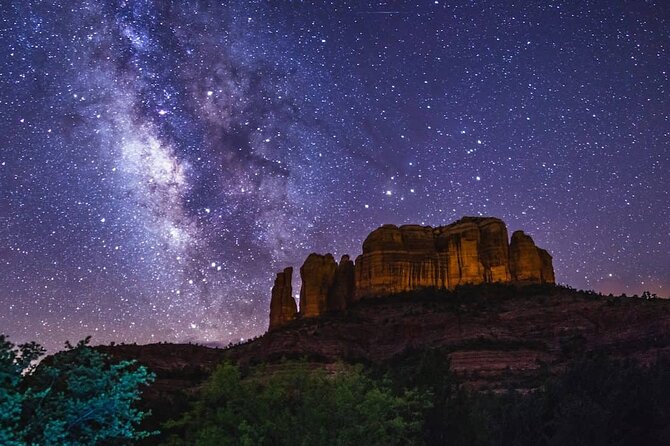
- You stay in one location: The tour begins and ends at 77 Cultural Park Place in Sedona, with chairs provided.
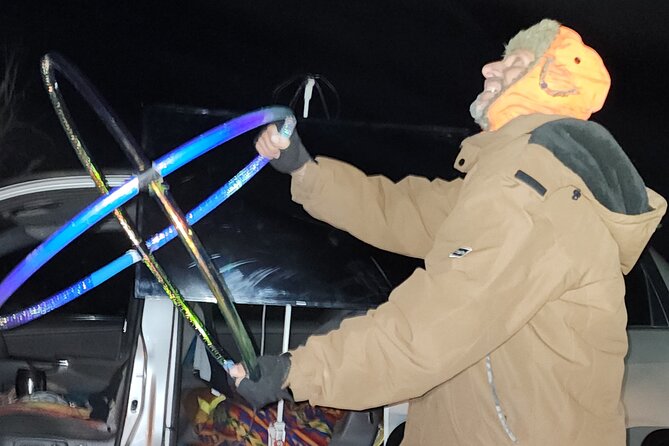
- Chad is the central attraction: His style is animated, humorous, physical, and highly personal, shaped by years of guiding and performing.
- The sky is viewed without telescopes: Expect naked-eye astronomy supported by a laser pointer and visual teaching tools.
- Stories range beyond Greek mythology: You hear local Indigenous star associations alongside constellation tales from Greek and Roman traditions.
- Cold-weather care is built in: Blankets and hand warmers are supplied, but you should still bring warm layers, gloves, and a hat.
- Clouds do not automatically ruin your booking: If the night is cloudy, you may request a full refund, even after staying for the presentation.
What this Sedona night tour is really about
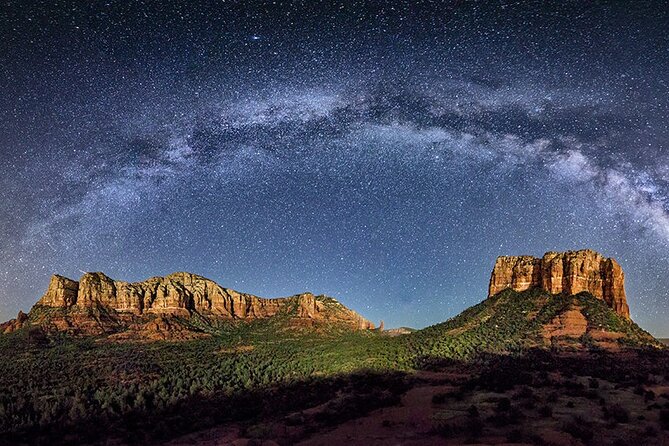
The title is long because the experience covers three subjects at once: constellation stories, big-picture astronomy, and Sedona’s own connection to the sky. Chad presents the heavens as something you can understand from your place on Earth, rather than as a display that requires expensive equipment.
The emphasis is on what your eyes can see. You may look for Orion, Sirius, Cassiopeia, Leo, Gemini, Taurus, the Pleiades, the Big Dipper, the Little Dipper, Jupiter, Saturn, and other visible objects, depending on the season and conditions. The exact lineup changes through the year, so an August sky will not look like a January sky.
I like this approach because you can use the skill again after the tour. Once you begin recognizing a constellation or understanding how stars appear to move, you do not need a telescope or an app to enjoy the night sky. The tradeoff is that you need to listen closely and take part. This is a lesson under the stars, not simply a viewing stop.
The experience is capped at 15 people. That is small enough for questions and participation, though the feel will depend on the final group size. Some sessions have been especially intimate, with only a few people present.
More Milky Way Tours in the USA:
- Milky Way Photography in Arches National Park
★ 4.0 · 4 reviews
Meeting Chad at 7:30 p.m.
The meeting point is 77 Cultural Park Place, Sedona. You remain there for the full activity, which lasts about two hours and five minutes, and return to the same spot at the end. Since there is no walking route between several attractions, wear shoes for sitting outdoors rather than preparing for a hike.
Chad has lived in the Sedona area since 1996 and began professional guiding in 2005. He says he has led thousands of tours and has spent more than six years running night-sky outings. His background also includes music, acting, dance, climbing, swimming, running, basketball, and martial arts. That helps explain the delivery: he does not teach from a fixed, quiet script.
Expect movement, jokes, questions, audience participation, and a strong personal connection to the subject. He may draw you into the story rather than simply point at the sky and name an object. Families have found that he can involve children, while adults interested in astronomy, mythology, local culture, or astrology have plenty to follow.
His energy is a major strength for the right audience. It also explains the main criticism: some people find the presentation repetitive or feel that the personal interaction takes too much time. If you prefer a tightly edited lecture, you may wish for a shorter route through the material.
The first lesson: finding your place in the cosmos
One of Chad’s main ideas is what he calls big-picture astronomy. Instead of treating each star as an isolated fact, he explains how Earth moves through the solar system and galaxy. The goal is to give you a sense of perspective while keeping the subject tied to objects you can see overhead.
The Play-Doh Milky Way is an especially memorable teaching device. A physical model can make the shape and scale of our galaxy easier to picture than a verbal explanation alone. The planisphere serves a more practical purpose, helping connect the date and time to the stars above you.
You may also see a large star app used during the session. This can help show the full arrangement of the constellations before you try to pick them out in the real sky. One useful point to understand before booking is that the app is a guide, not a substitute for looking upward. The point is to move from the visual aid to the actual sky.
Some people have wished for the star app and constellation layout to appear earlier. If you are new to astronomy, ask questions when you lose track of a constellation. The session is participatory, and clarification is part of the format.
Greek myths, local traditions, and the stories overhead
The constellation stories are the heart of the tour. You hear Greek and Roman mythology tied directly to the shapes and positions of the stars, rather than receiving a general mythology lecture indoors. Familiar figures can take on new meaning once you see how ancient people connected them to the night sky.
Chad also discusses local Indigenous associations with the stars. This gives the presentation a broader cultural frame and helps show that the sky has never belonged to one tradition. Different communities have used the same stars to preserve stories, mark time, explain the world, and pass on knowledge.
The best part is the connection between story and observation. You are not just hearing that a constellation has a myth. You are encouraged to see the pattern, follow its movement, and understand why it mattered to people who watched the sky without modern instruments.
The tone is not solemn throughout. Pop culture references, songs, humor, and even an odd mention of a chicken and rooster may appear along the way. That mixture can make an unfamiliar subject easier to remember. It can also feel loosely structured if you prefer a strict sequence of facts.
More Stargazing Tours in the USA:
- Small Group Big Island Twilight Volcano and Stargazing Tour
★ 5.0 · 1,619 reviews - Griffith Observatory Hike: Guided Tour through Griffith Park
★ 5.0 · 1,020 reviews - Sedona Stargazing Tours LLC
★ 4.5 · 881 reviews - Miami: Frost Museum of Science and Planetarium Entry Ticket
★ 4.5 · 429 reviews
Using the laser pointer to get your bearings
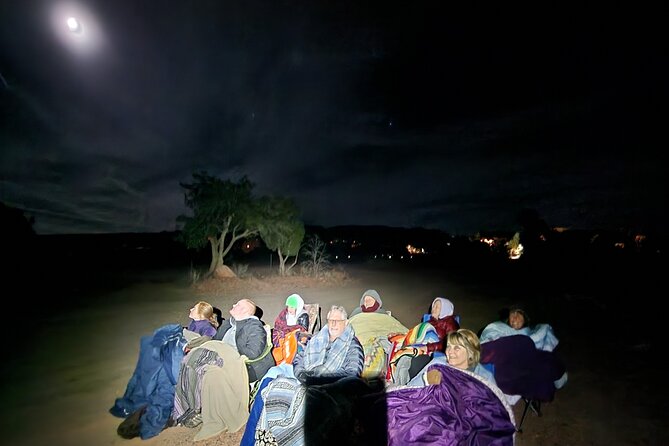
The laser pointer is one of the most useful parts of the experience. On a clear night, it gives you a direct line from the explanation to the stars themselves. Instead of staring at a broad patch of sky and wondering which point matters, you can follow the beam and then try to locate the pattern without help.
This is particularly helpful for first-time sky watchers. Constellations rarely look as obvious in real life as they do in a book or phone app. The laser pointer bridges that gap, showing you the relationship between the imagined lines and the actual stars.
You may see bright objects such as Sirius, planets including Jupiter or Saturn, and well-known groups such as the Pleiades. Visibility depends on the season, the moon, cloud cover, and local conditions. A clear August sky can show a different collection from a clear winter night, so do not book expecting one fixed list.
The experience may also include shooting stars. One clear evening produced 11 sightings, but that is a fortunate condition rather than a promise. The tour’s value should rest on the teaching and storytelling, with extra celestial events treated as a bonus.
Cold chairs, blankets, and a Sedona night
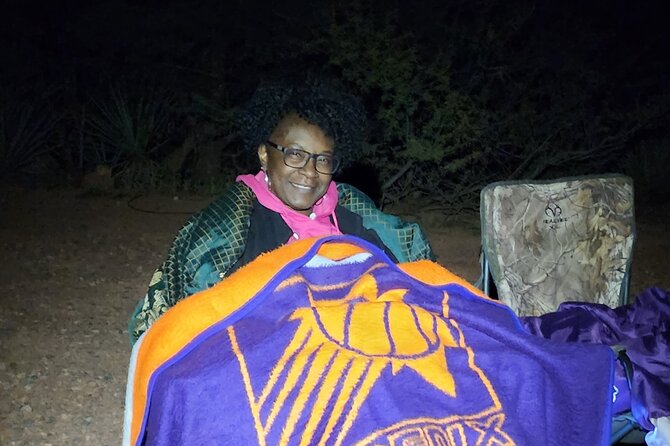
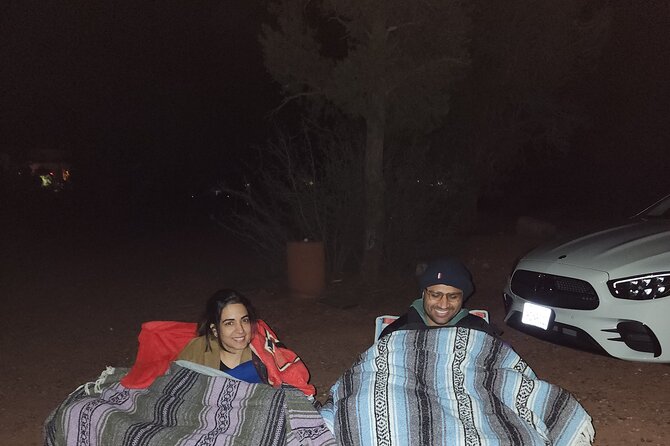
Sedona can feel much colder after sunset than visitors expect, especially during winter. The tour provides chairs, blankets, and hand warmers, and these practical touches matter because sitting still for two hours can make you feel cold even when the evening begins pleasantly.
Bring warm clothes anyway. Gloves, a stocking cap, and layers are sensible in the colder months. The supplied blankets and warmers help, but they do not replace a proper jacket. You should also remember that the activity stays in one place, so there is little movement to keep you warm.
The setting can be comfortable and relaxed when the weather cooperates. You sit, listen, look up, and take part rather than walking from one viewpoint to another. Do not bring alcohol or pets. Service animals are allowed.
Clouds are the one major variable. Sedona is usually dry, but clear skies are never guaranteed. If clouds interfere, you can choose to cancel for a full refund at your discretion, including after staying for the presentation. The stated cancellation rule normally requires 24 hours’ notice, but this weather arrangement is more flexible and gives you a fair way to handle an unusable sky.
Is $100 a fair price?
At $100 per person, this is not the cheapest way to spend an evening in Sedona. You are paying for more than a short constellation identification session, though. The price covers roughly two hours of guided instruction, a small-group format, visual tools, the laser pointer, seating, blankets, hand warmers, and Chad’s years of guiding experience.
The value depends on what you want. If you are interested in stories, astronomy, local culture, and a guide who teaches with humor, the price can make sense. You leave with concepts you can use later, not just a few photographs or a quick look through a telescope.
If your main goal is high-powered viewing of distant planets or galaxies, this is the wrong purchase. There is no promise of telescope time, and the session is not built around technical equipment. You may see far more with your eyes on a clear night, but the instruction remains the main event.
The high overall rating of 4.7 from 243 ratings and a 92 percent recommendation rate suggest that the format works well for most people. Still, the lower scores point to a real issue: the presentation can feel too long, too personal, or too story-heavy for someone expecting a hands-on stargazing session. Read the description honestly before paying.
Who will enjoy this most?
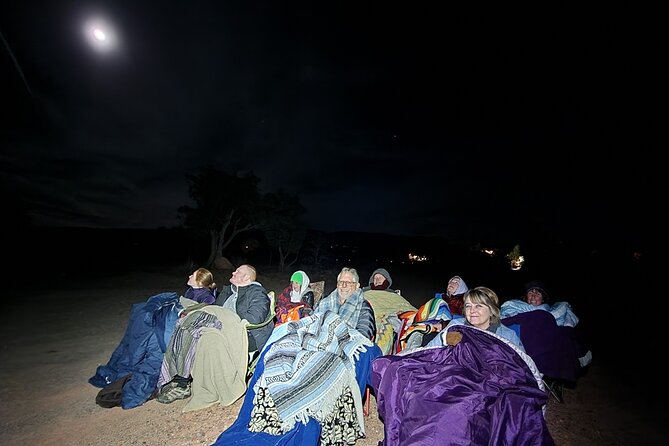
I would choose this tour for you if you enjoy learning through stories and do not mind an animated guide. It suits couples, families, solo visitors, and small groups. Going alone is not a problem, especially when the group is small and participation is encouraged.
It is also a good fit for someone who knows little about astronomy. You do not need to arrive with a list of constellations memorized. The visual aids and laser pointer are meant to help you build a basic map of the sky.
You may enjoy it if you already like astronomy, too, particularly if you are curious about mythology and Indigenous star traditions. The session is not aimed only at beginners. It connects familiar constellations to different cultures and adds a broader view of how people have understood the heavens.
I would hesitate to recommend it to you if you want silence, a short technical briefing, or a telescope. I would also warn you if you dislike audience participation or a guide who makes himself part of the entertainment. Chad’s enthusiasm is central to the experience, not a side note.
Practical booking advice for clear skies and comfort
The activity starts at 7:30 p.m., but the actual darkness and visible objects will vary through the year. Check the date carefully if a certain constellation or planet matters to you. The listed highlights change with the season.
Book at least a day ahead if you need the standard free-cancellation option. You can cancel up to 24 hours before the start time for a full refund. Changes made inside that window are not accepted under the normal policy, but poor weather has its own full-refund provision.
The experience is offered in English, uses a mobile ticket, and is near public transportation. Most people can participate, and service animals are permitted. The maximum group size is 15, which makes it easier to ask a question than on a large coach excursion.
Wear more than you think you need. A warm hat and gloves take little room and can make the difference between enjoying the final half-hour and wishing the session would end.
Should you book the Night Sky Star Story, Galaxy, and Sedona Story Tour?
Book it if you want a lively, story-driven introduction to the stars and like the idea of learning without a telescope. Chad’s laser pointer, physical models, local cultural references, humor, and clear passion give the evening a personality that a standard star chart session may lack.
Skip it if your definition of stargazing means quiet observation through powerful equipment. The tour is a presentation first and a viewing experience second. Clouds can also limit what you see, though the flexible weather refund takes much of the financial risk away.
For most people who arrive expecting stories, participation, and naked-eye astronomy, this is a memorable way to finish a Sedona day. Bring warm layers, arrive ready to look up, and treat any shooting stars as a gift rather than part of the contract.
FAQ
Where does the tour begin and end?
It begins at 77 Cultural Park Place in Sedona, Arizona, and ends back at the same meeting point.
What time does the activity start?
The listed start time is 7:30 p.m.
How long does the tour last?
The experience lasts approximately two hours and five minutes.
Does the tour use a telescope?
No. The focus is on what you can see with your own eyes. Chad uses a laser pointer, planisphere, Play-Doh Milky Way, a star app, and other visual aids.
What subjects does Chad cover?
The presentation includes Greek and Roman constellation stories, local Indigenous star associations, big-picture astronomy, the movement of stars, and connections between the sky and Sedona.
What should I wear?
Dress warmly, especially in winter. Blankets and hand warmers are provided, but you should bring warm layers, gloves, and a hat.
What happens if the night is cloudy?
Clouds may lead to a full refund at your discretion. You can request the refund even if you stay for the entire presentation. If the activity is canceled because of poor weather, you can also choose another date or receive a full refund.
Can I cancel for another reason?
You can cancel up to 24 hours before the start time for a full refund. Cancellations or changes made less than 24 hours before the activity are not accepted under the standard policy.
Fresh listings near the USA
- Boulder: Guided Astronomy Tour★ 4.7 · 11 reviews
- 1-Day Grand Canyon Tour from Las Vegas: Stargazing & Sunrise★ 3.6 · 3 reviews
- Private Stargazing – Sequoia National Park★ 4.5 · 14 reviews
- Private Tour of Griffith Observatory★ 4.5 · 58 reviews
- Milky Way Photography in Arches National Park★ 4.0 · 4 reviews
- Professional Stargazing in Moab★ 3.5 · 3 reviews
- Haleakala Sunset and Astronomy Tour★ 5.0 · 33 reviews
- Haleakala Sunset and Stargazing Audio Tour★ 4.0 · 10 reviews
Sedona Stargazing, side by side.


The Original Sedona UFO and Stargazing Night Tour
Read our review →
Sedona Dark Sky Sunset & Night Hike With a Private Guide
Read our review →Lists this night appears in