
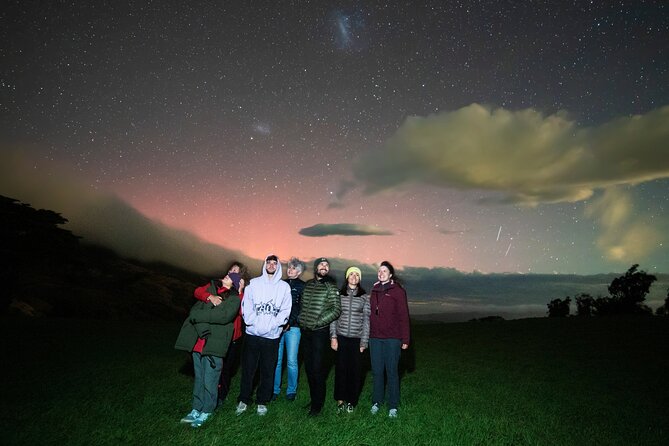
REVIEW · NEW ZEALAND STARGAZING
Night Awe – Stargazing tour in Akaroa
Akaroa’s best night view is above you. Away from city lights, this small-group outing uses a 10-inch Dobsonian telescope for direct viewing and a smart ZWO Seestar S50 for live astrophotography. Astronomer Luca guides you through planets, nebulae, galaxies, and the Milky Way without expecting any prior astronomy knowledge.
I like the maximum group size of 10, which gives the evening a personal feel, and I like that you take home more than a memory: deep-sky images arrive during the session, while a digital photo of you beneath the stars is sent the next day. The hot drink and blankets are useful touches in Akaroa’s night air.
The main consideration is weather. This is an outdoor astronomy experience, so clouds can cancel the session or limit what you see. You also need to make your own way to Akaroa Heritage Park, since transport is not included.
Key points at a glance
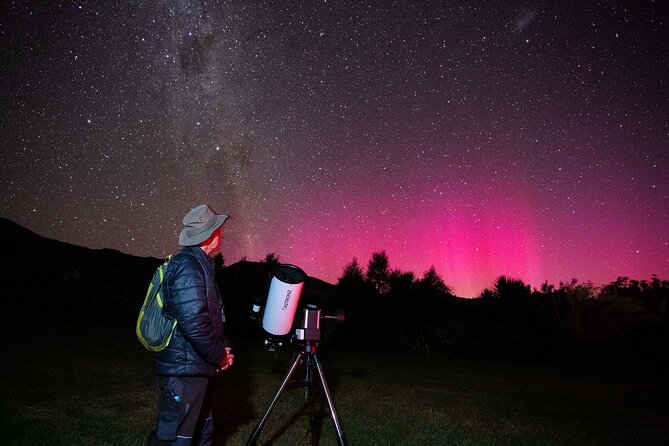
- Two very different telescopes: The 10-inch Dobsonian gives you direct visual views, while the ZWO Seestar S50 creates live digital images of deep-sky objects.
- A personal guide: Astronomer Luca leads the session and explains distances, planets, and constellations in everyday terms.
- A small group of up to 10: You have a better chance to ask questions and get time at the equipment.
- Souvenirs included: Nebula and deep-sky photos are shared during the tour, with a personalized night-sky portrait sent the next day.
- Comfort is built in: Coffee or tea and cozy blankets help during the 90-minute outdoor session.
- Simple location: Meet at Akaroa Heritage Park, 280 Long Bay Road, only a short distance from town.
Why Akaroa is a fine place to look up
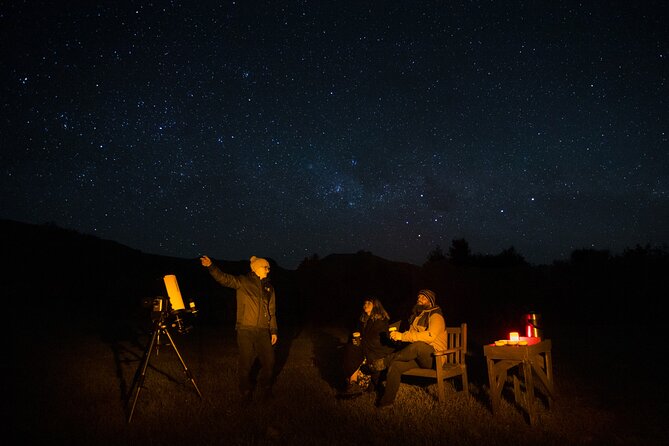
Akaroa gives this outing a useful advantage: the activity takes place away from the strongest city lights. That matters because faint objects are easier to see against a darker sky. The stars are not just decoration here. Darkness is the main ingredient.
The experience begins with your naked-eye view of the sky. That first look is important. Before the equipment comes out, you can get a sense of the scale above you and begin to pick out the main patterns. From there, binoculars and telescopes take you farther.
I like this order because it keeps the evening from becoming a mechanical queue for the telescope. You first look up as a person, then you use the equipment to make sense of what you are seeing. Luca’s role is to connect those two views, explaining the sky in a way that makes distances easier to grasp.
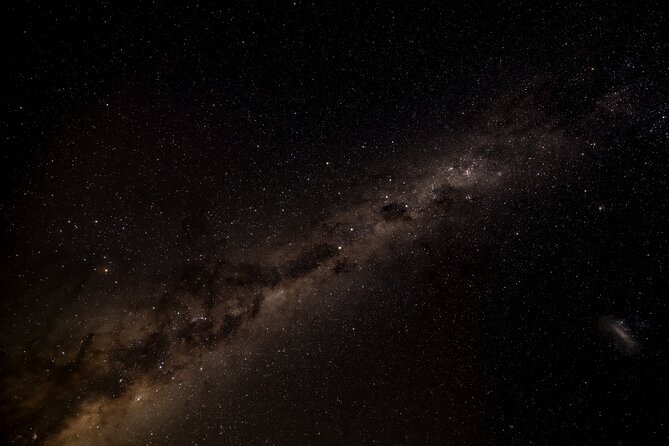
The Southern Hemisphere also gives this outing its own character. You are not simply repeating a northern-hemisphere stargazing routine. The tour is designed around the night sky visible from Akaroa, with planets, nebulae, galaxies, and the Milky Way among the possible targets.
More Stargazing Tours in New Zealand:
- Lake Tekapo: Alpine Stargazing Experience with a Guide
★ 4.5 · 626 reviews - Lake Tekapo: Stargazing Experience
★ 4.9 · 607 reviews - Chameleon Stargazing Shared Tour
★ 5.0 · 181 reviews
Meeting Luca at Akaroa Heritage Park
You meet at Akaroa Heritage Park, at 280 Long Bay Road. The tour begins and ends at this meeting point, and there is no private transportation included. If you are staying in Akaroa, plan your route before nightfall and allow enough time to arrive without rushing.
The setting is practical rather than elaborate. You are not being taken on a long drive into the countryside or asked to hike to a remote viewpoint. That makes the experience easier to fit into a stay in Akaroa, especially if you want an evening activity close to town.
The tour runs for about 1 hour and 30 minutes. That is long enough to move from a general introduction to detailed telescope viewing, but short enough to avoid turning the night into a major commitment. You should still dress for an outdoor evening, since blankets and a hot drink add comfort but do not replace warm clothing.
Luca is the guide and the founder and owner of Akaroa Stargazing. His style, based on the way the session is presented, is enthusiastic and personal. He encourages questions and explains the sky rather than simply naming objects. That helps if you know little about astronomy, but it also gives people with more interest a chance to ask about what they are seeing.
The first view is with your own eyes
The opening stage uses the naked eye, followed by binoculars and telescopes. This simple progression works well for beginners. If the first thing you see is a complicated instrument, it is easy to lose the larger sense of wonder. Starting without equipment helps you understand that astronomy begins with looking up.
Luca points out constellations and planets, then gives context for the objects in view. One useful feature is his use of distances that you can relate to. Numbers in astronomy can become meaningless very quickly. A good comparison gives you a firmer sense of how far away a planet, nebula, or galaxy really is.
You do not need prior astronomy knowledge. That is worth noting for families, couples, and anyone who has always wanted to try stargazing but worried about not knowing the names of stars. The format is guided, so you are not left to work out what to look for on your own.
The session can also suit people who already know a little. On a clear night, there are many possible objects to examine, and the guide can respond to questions as they arise. The small group limit helps here. With no more than 10 people, the evening has more room for conversation than a large coach-style activity.
The 10-inch Dobsonian gives you a direct look
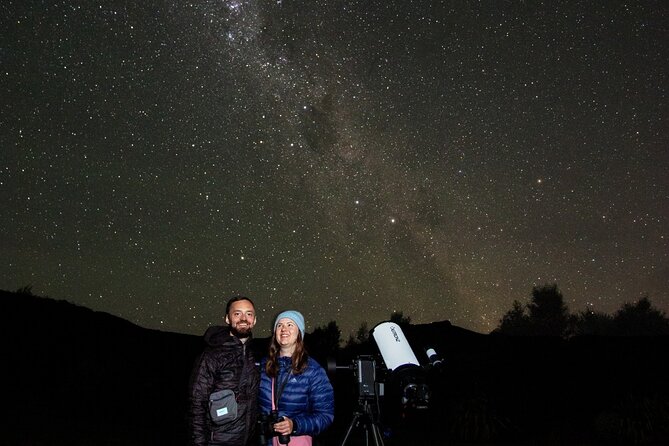
The first main telescope is a 10-inch Dobsonian. This type of telescope is valued for visual observing, and here it provides the chance to look directly through the eyepiece at planets and deep-sky objects.
That direct view is different from looking at a finished photograph. You are seeing light gathered by the telescope and presented to your eye. The view may not look like a brightly colored space image from a science book, but it can feel more immediate because you are observing the object through the instrument in real time.
This is where Luca’s explanations matter. A small blur or bright point can mean little without context. His job is to tell you what you are looking at and why it matters, while helping you get the most from the view.
The Dobsonian is also a good fit for a short group session. It offers a clear purpose to the equipment portion of the evening, while Luca can guide people through different objects instead of leaving everyone to guess what the telescope is aimed at.
You should keep expectations sensible. Astronomy depends on conditions, and the exact objects visible will vary with the night sky. The tour promises access to planets, nebulae, galaxies, and the Milky Way, but no fixed list of sights is given. The fun is partly in seeing what conditions allow on your date.
Same sky over New Zealand, a different way to watch it:
- Lake Tekapo: Mountaintop Stargazing at Mount John Summit
★ 4.5 · 176 reviews - Mount John Observatory Stargazing Experience, Tekapo
★ 4.5 · 160 reviews - Tekapo Star Gazing Tour – Soak in the Stars
★ 4.5 · 109 reviews - Silver River Stargazing Experience in Lake Tekapo
★ 4.5 · 106 reviews
The Seestar S50 adds a modern photo angle
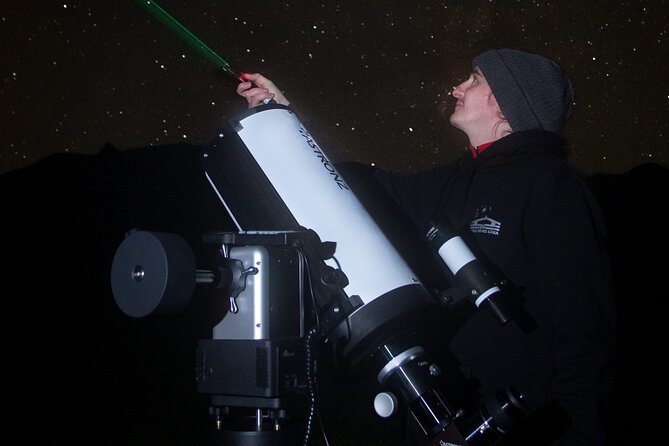
The ZWO Seestar S50 smart telescope provides a very different experience. Instead of relying only on your eye at the eyepiece, the telescope captures live astrophotography of nebulae and other deep-sky objects.
Images are shared during the session, ready for you to keep or post. This is a strong feature for people who want a clear visual souvenir of what they saw. It also helps show details that are difficult to notice in a quick visual look through a telescope.
I especially like the contrast between the two instruments. The Dobsonian gives you the traditional, direct experience. The Seestar S50 gives you a digital image that can reveal more structure and can be shared immediately. One is about the moment at the eyepiece, and the other gives you something concrete to take away.
The instant photos should not be confused with a private professional astrophotography session. The activity is a guided group tour, and the images are part of the wider experience. Still, they add real value at this price because you are not paying only for a talk and a chance to look through a telescope.
Digital keepsakes make the night easier to remember
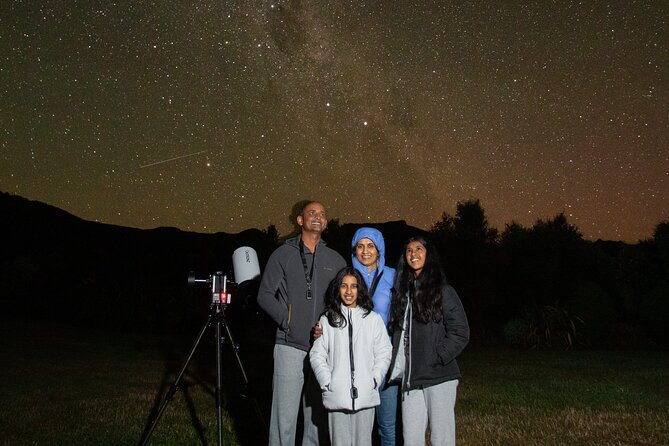
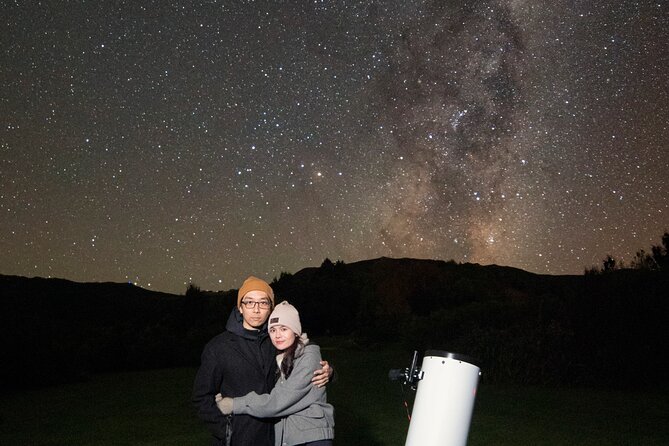
Along with the deep-sky images, you receive a personalized digital souvenir photo under the night sky. This image is sent the next day and can feature you or your group.
That small addition makes the tour more personal. A nebula image tells you what the telescope saw, while the portrait connects the evening to your own visit to Akaroa. If you are marking a birthday, anniversary, or special stop on a New Zealand trip, the photo gives the activity a lasting record.
The two kinds of images also serve different purposes. The telescope photos are about astronomy. The personal photo is about your time in Akaroa. You do not have to choose between a scientific keepsake and a travel photograph.
The next-day delivery is worth remembering when you book. You should not expect the personalized image immediately at the end of the session. The deep-sky photos are shared during the evening, while the personal souvenir arrives later.
Blankets and hot drinks matter after dark
Coffee or tea and cozy blankets are included. These may sound like minor details, but comfort can shape how much you enjoy a night outdoors. Once you stop moving and begin looking through equipment, you notice the cold more quickly than you would during a walk.
The blanket is especially useful while you wait for your turn at the telescope or listen to an explanation. The hot drink gives you a simple way to warm up and makes the evening feel more welcoming.
You should still wear suitable clothing. The information provided does not specify a dress code or weather gear, so use practical judgment for an outdoor night in Akaroa. The tour is comfortable by design, but blankets cannot control the temperature or the wind.
Is $67.64 a fair price?
At $67.64 per person, the tour is priced as a small-group specialist activity rather than a basic lookout stop. You are paying for about 90 minutes with an expert astronomer, access to two types of telescope, digital deep-sky photos, a personal souvenir image, a hot drink, blankets, and all fees and taxes.
The strongest value comes from the combination of instruction and equipment. You are not simply being shown a star map. You get both a 10-inch Dobsonian and a smart telescope, each offering a different way to see the sky.
The group limit also matters. A maximum of 10 people gives the session a more personal scale, and it makes questions more practical. A much larger group could lower the price, but it might also mean less time at the equipment and less direct contact with Luca.
The price will feel worthwhile if you value guided explanation and the chance to leave with images. It may feel less attractive if you only want a quick look at the stars or if cloudy weather makes you uncomfortable booking an outdoor activity. Since conditions can affect the experience, this is a tour where flexibility matters.
Who will enjoy this most?
This is a strong choice for first-time stargazers. You do not need technical knowledge, and Luca explains the sky in accessible terms. Parents may also appreciate the 90-minute length, since it offers a focused evening activity without taking over the entire night.
It suits couples and small groups who want something different from daytime sightseeing. The personalized photo adds a nice record for a special occasion, while the instant nebula images give you something to share soon after the session.
It can also work for people with a real interest in astronomy. The tour does not appear limited to a basic introduction, since the guide welcomes questions and the available equipment can show a range of objects. The exact experience will depend on the weather and what is visible that night.
You may want to skip it if you dislike outdoor evening activities, need guaranteed sights, or cannot arrange your own transport to Akaroa Heritage Park. This is a sky-dependent experience, not a theater show with a fixed program.
Weather, cancellations, and practical planning
Good weather is required. If poor conditions force a cancellation, you can choose a different date or receive a full refund. You can also cancel for a full refund up to 24 hours before the start time, but changes or cancellations inside that 24-hour window are not accepted.
That policy makes it sensible to keep your plans flexible if clouds are forecast. Check the local weather before you go, but remember that the final decision depends on whether the night is suitable for stargazing.
Confirmation is provided at booking, and mobile tickets are supported. Service animals are allowed, and the activity is suitable for most people. The tour ends back at the meeting point, so you do not need to arrange a second pickup location.
Should you book Night Awe?
Book it if you want a guided introduction to the Southern Hemisphere sky with a small group, useful explanations, and more than one way to view the stars. The combination of Luca’s personal astronomy talk, the Dobsonian, the Seestar S50, instant deep-sky photos, and a next-day portrait gives the $67.64 price solid value.
I would be most confident recommending it to people staying in or near Akaroa who can handle a cool outdoor evening and accept that weather may change the plan. If the sky is clear, the experience offers both the quiet pleasure of looking up and the practical fun of seeing what modern equipment can capture.
FAQ
Where does the Night Awe stargazing tour begin?
It begins at Akaroa Heritage Park, 280 Long Bay Road, Akaroa 7583, New Zealand.
Where does the tour finish?
The activity finishes back at the Akaroa Heritage Park meeting point.
How long does the experience last?
The stargazing session lasts approximately 1 hour and 30 minutes.
How many people can join the tour?
The tour has a maximum group size of 10 people.
Who leads the stargazing experience?
The session is led by Luca, an astronomer and the founder and owner of Akaroa Stargazing.
Do I need astronomy experience?
No. Prior astronomy knowledge is not required, and Luca guides you through the night sky and answers questions.
What equipment is included?
You can use a 10-inch Dobsonian telescope and a ZWO Seestar S50 smart telescope. Binoculars are also used during the introduction to the sky.
Are drinks and photos included?
Yes. Coffee or tea, cozy blankets, digital photos of nebulae and deep-sky objects, and a personalized digital photo under the night sky are included. The personal photo is sent the next day.
What happens if the weather is poor?
If poor weather causes the activity to be canceled, you can choose another date or receive a full refund.
Can I cancel my booking?
You can cancel for a full refund up to 24 hours before the experience start time. Cancellations or changes made less than 24 hours before the start time are not accepted.
Fresh listings near New Zealand
- Twizel: Stargazing Tour with an Astronomer and Telescope★ 4.9 · 36 reviews
- Twizel Stargazing Experience with a Guide (Carbon Positive)★ 4.7 · 26 reviews
- Private Stargazing at Star Safari near Martinborough★ 5.0 · 3 reviews
- Star Safari Stargazing Experience, Martinborough★ 5.0 · 6 reviews
- Twizel Stargazing Experience with a Guide (Carbon Positive)★ 4.0 · 2 reviews
- Lake Tekapo Ultimate Stargazing Experience★ 5.0 · 3 reviews
- Virtual Stargazing & Astronomy Experience in Lake Tekapo★ 3.0 · 2 reviews
- Southern Skies Stargazing Tour in Dunedin★ 5.0 · 62 reviews
New Zealand Stargazing, side by side.
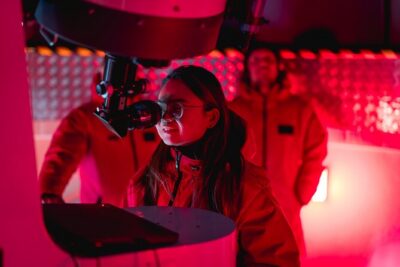
Mount John Observatory Stargazing Experience, Tekapo
Read our review →
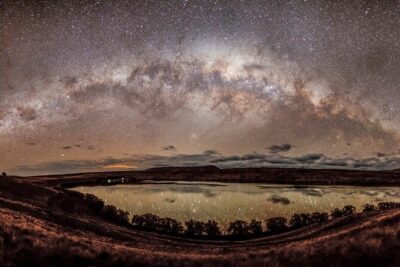
Silver River Stargazing Experience in Lake Tekapo
Read our review →
Stargazing Experience at Cowan’s Private Observatory
Read our review →Lists this night appears in