
REVIEW · TELESCOPE STARGAZING
Stargazing Tour with Telescopes and Video Astronomy in Sedona
Sedona’s red rocks are famous by day, but the real surprise comes after sunset, when the sky opens into a field of stars. This 75-minute outing takes you away from city lights to a dark-sky site, where Chris and Kim use a laser, large telescopes, and live 4K video to show everything from planets to faint galaxies. The live screen is the clever touch: everyone sees the same object at once, in color and detail.
I like two things here. First, the small group limit of 12 keeps the night personal rather than turning it into a line at a telescope. Second, you can leave with images from the session, not just a fading memory of Saturn’s rings or a distant nebula. The main drawback is simple: this is an outdoor night activity, and cold, clouds, uneven ground, or a slow setup can affect the experience.
Key points to know
- Live 4K video astronomy: Astronomy cameras send faint deep-space objects to a large OLED monitor so the whole group can watch together.
- Two ways to see the sky: You may look directly through premium eyepieces while also viewing detailed camera images on the screen.
- Small groups up to 12: The format allows time for questions and a closer look at the equipment.
- Dark-sky locations outside town: The guide directs you to a secluded site on forest land or private ranch property.
- Warmth is provided, but dress warmly: Chairs and heavy blankets are available, yet coats, gloves, hats, and warm layers still matter.
- The meeting location is shared later: Chris provides clear directions and may call before the outing, but you will not receive the exact site immediately at booking.
Why Sedona’s night sky is worth your evening
I often think of Sedona as a daytime destination: red cliffs, desert trails, and sunset viewpoints. Yet the area’s dark skies offer a completely different reason to stay out after dinner. Away from the town’s lights, familiar constellations become easier to pick out, and the Milky Way can look far more substantial than it does from a city or suburb.
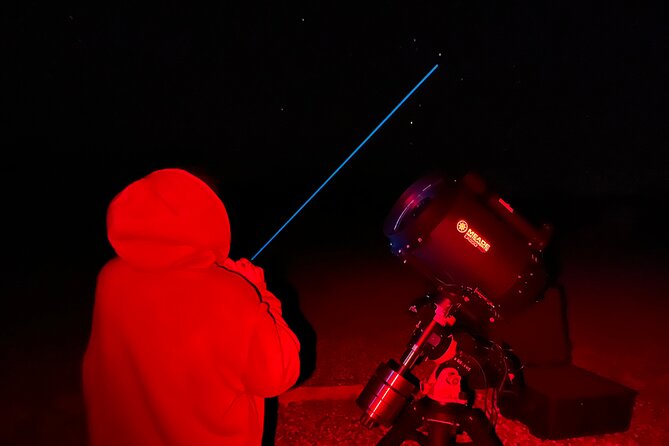
This is not simply a session where someone points at a few bright stars and sends you home. Chris uses a laser to trace constellations and explain what you are seeing. Depending on the season and conditions, the program can include planets, meteor activity, passing satellites, star clusters, nebulae, and galaxies.
The changing sky is part of the appeal. A winter visit can bring a crisp, star-filled night and a different set of visible objects than a summer outing. The tour does not promise a fixed list because astronomy depends on the date, weather, and what is above the horizon. That is a good thing, but it also means you should come for the experience of learning the night sky rather than one guaranteed planet.
More Telescope Stargazing in Sedona:
- Sedona: Stargazing Tour with Telescopes and Video Astronomy
★ 4.8 · 9 reviews - Teide by Night: Sunset & Stargazing with Telescopes Experience
★ 4.5 · 1,492 reviews - Uluru: National Park Astronomy Tour with Telescope and Photo
★ 4.4 · 357 reviews
A 75-minute route into the dark
The itinerary has one stop, but that does not mean the experience feels thin. The stop is a secluded viewing site outside Sedona, and the shift away from town lights is the key part of the outing.
You meet in the Sedona area and receive directions to the exact location. The meeting point is not fully disclosed at the time of booking, so that may cause a little uncertainty if you like to plan every turn in advance. Chris has called participants before departure and provided clear instructions, which helps. Give yourself enough time to arrive promptly, especially since the location can be harder to find after dark and one outing had too few signs for a completely effortless arrival.
At the site, chairs are set out and blankets may be available. The location is generally arranged so you can view the sky without needing to negotiate a rough trail, although uneven ground and low light remain possible. That matters for anyone who moves slowly or feels unsteady outdoors at night.
The session begins with the unaided sky. You may see constellations, the Milky Way, planets, meteor activity, or satellites before the telescopes come into play. This opening gives you a useful frame of reference. Instead of seeing the telescope as a magic box, you start to understand where an object sits in relation to the constellations around it.
Two telescopes, two kinds of viewing
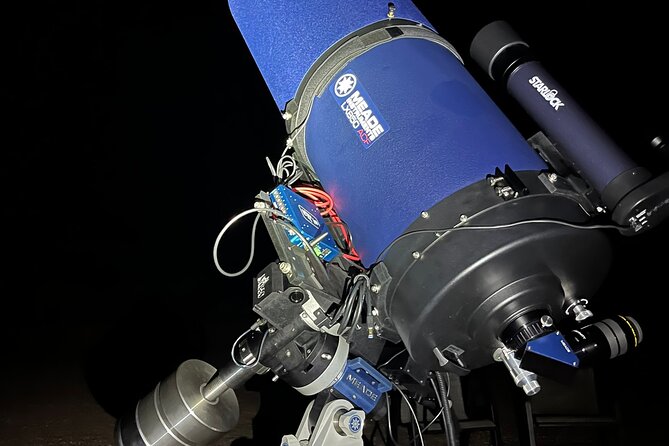
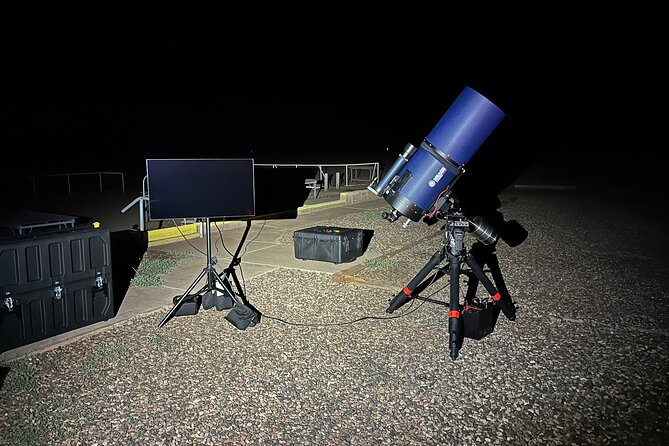
The equipment is the heart of the tour. Night Owl Tours uses large-aperture, observatory-style telescopes with high-quality eyepieces. One telescope can provide the classic experience of looking directly through the instrument. You may see a planet, star cluster, or other bright object in the eyepiece, with the satisfaction of finding it in the sky yourself.
The second telescope is fitted with an astronomy camera. Rather than sending each person to take a turn at an eyepiece, the camera captures live video of faint objects and sends it to a 4K OLED screen. This is especially useful for galaxies and nebulae, which can be difficult to see clearly through a traditional eyepiece.
The screen also solves a common problem with group astronomy outings: only one person can look through a telescope at a time. Here, the whole group can see the same image together. Chris can explain what you are looking at while everyone has the object in front of them, rather than asking the group to take turns and then describe what they saw.
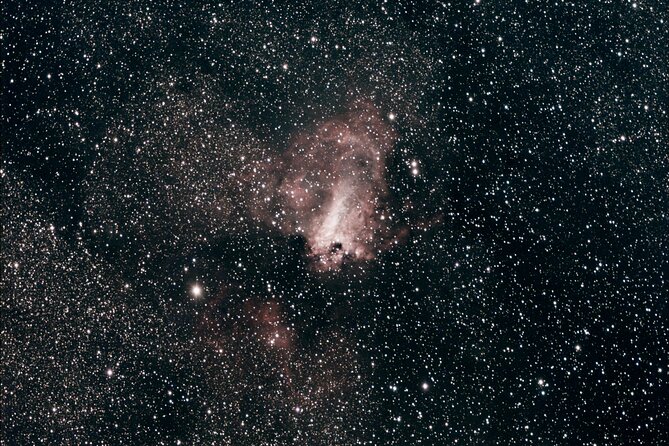
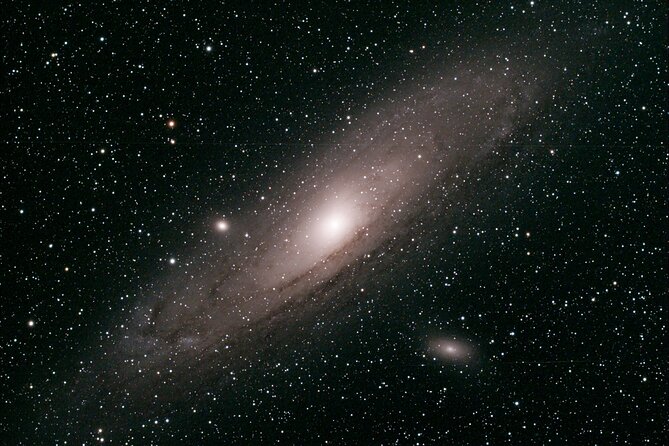
The images are not simply generic stock pictures. The gallery images represent views captured by the tour’s own telescopes, and favorite images from your session can be saved afterward. That gives the activity a useful middle ground between direct observation and astrophotography. You are still seeing the sky live, but the camera brings out color and structure your eyes may not catch on their own.
Chris and Kim bring science down to earth
Chris is the main guide named throughout the experience, and Kim may assist. Chris explains astronomy with both a quick, plain answer and a more scientific explanation when a question calls for it. That is a good fit for a mixed group, since a child, a casual observer, and someone taking an astronomy course can all get something from the same talk.
The tone is educational without needing to be stiff. Chris covers science, the history of astronomy, and stories connected to the stars, with some humor along the way. The emphasis is clearly on understanding what you are seeing, not rushing through a checklist of objects.
I especially like the way this format can work for families with older children. The minimum recommended age is seven, and the program suits an eight-year-old who can stay attentive during a technical explanation. Teenagers with an interest in science may get more from the live camera system and galaxy views than from a standard sightseeing stop.
Adults who already know the basic constellations will still find something to enjoy. The guides can explain how objects formed, how to find them again, and why some appear better through the camera than the eyepiece. You are not required to arrive with any astronomy background.
More Stargazing Tours in Sedona:
- Sedona Stargazing Tours LLC
★ 4.5 · 881 reviews - The Original Sedona UFO and Stargazing Night Tour
★ 4.5 · 269 reviews - The Night Sky Star Story, Galaxy, and Sedona Story Tour
★ 4.5 · 243 reviews - Sedona: Nighttime UFO & Stargazing Tour
★ 4.4 · 148 reviews
What you might see through the scopes
The exact menu changes with the date and sky conditions, but the tour can cover a broad range of objects. Bright planets may show surface features or moons. One session included Jupiter and four of its moons, Mars, and Saturn’s rings. Those are the sort of views that make the telescope feel worth bringing to a remote site.
Star clusters can appear as dense groups of points, while nebulae show clouds of gas and dust connected to the birth or death of stars. Galaxies are farther away and often more demanding to see, which is where the live camera becomes especially helpful.
You might also spot satellites moving steadily across the sky. Meteor showers are possible at the right time of year, but they are not guaranteed. The guide can point out the Milky Way and trace constellations with a laser, helping you connect the science with the sky above you.
The direct telescope view and the monitor view should not be treated as competitors. The eyepiece gives you the personal act of looking through a telescope. The screen gives you a brighter, more detailed picture and lets the entire group share the moment. Having both options makes the program more flexible than a basic naked-eye stargazing talk.
Cold nights, dark ground, and practical comfort
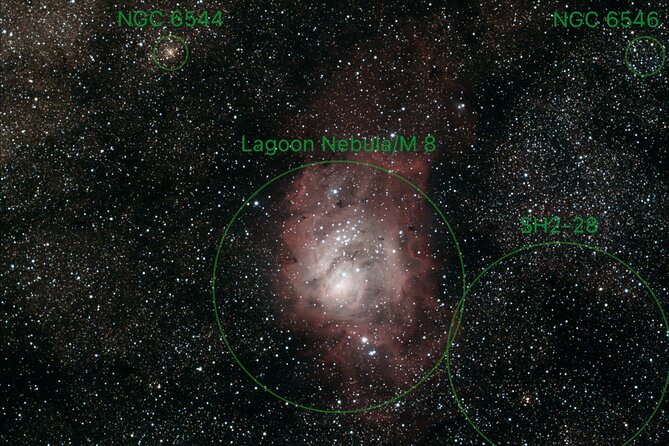
A Sedona night can feel cold even when the daytime temperature was pleasant. Several sessions used chairs and large, heavy blankets, which made a real difference in winter. Still, I would dress as if you are going to spend more than an hour standing or sitting outdoors: bring a warm coat, gloves, a hat, and layers.
Coffee, tea, and snacks are not included. Do not count on hot chocolate being available. Eat beforehand and bring anything you need, as long as it fits the activity’s rules and does not interfere with the equipment.
The site is away from city lights, which is exactly why you book it, but darkness brings practical concerns. You may need to walk over uneven ground in low light. The activity may not suit anyone who has difficulty with that, and it is not intended for children under seven.
The setting may not feel perfectly isolated every night. A parking area can mean a passing car or headlights during the presentation. That slightly weakens the atmosphere, but it can also be safer and easier than walking along an unpaved trail in the dark.
Group size and pace matter here
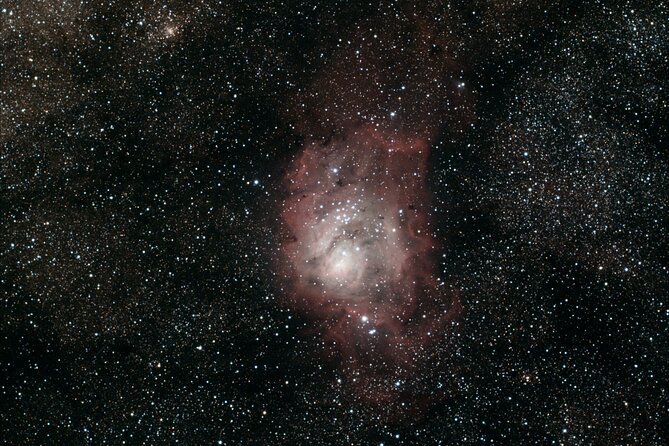
The maximum group size is 12. That is small enough for questions and gives the guides a chance to manage the telescopes without turning the experience into a public lecture.
The pace can vary. On a smooth night, the program moves from constellations to telescope targets and live screen views with plenty of time for questions. On a night with clouds or equipment adjustments, the flow may slow down. One difficult session involved a delayed setup, long pauses between objects, and clouds that eventually limited the viewing. The operator offered a refund in that case.
That experience points to a fair consideration: this is a specialist activity run with complex equipment, not a stage show with a guaranteed script. Most of the time, the technology adds a lot. But when setup takes longer than expected or clouds roll in, the 75-minute schedule can feel less efficient.
Arrive on time. The guide may be preparing equipment before the official start, and a late arrival can interrupt the group and make it harder to follow the explanations.
Is $125 a fair price?
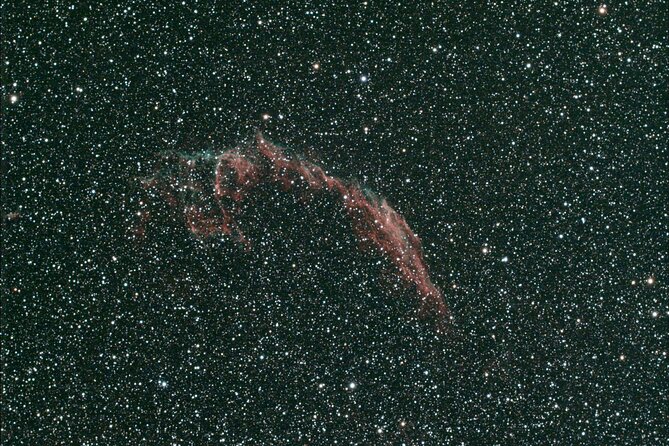
At $125 per person, this is not a budget after-dark activity. You are paying for more than a quick look through a small backyard telescope. The price includes a small group, access to a dark-sky site, large-aperture scopes, a live 4K display, guide instruction, chairs, and blankets when needed. You also have the chance to save images from the session.
The value is strongest if you care about astronomy or want a serious introduction to the night sky. The live camera system is a real difference from a basic stargazing talk, especially for faint galaxies and nebulae. You are also paying for the guide’s preparation, equipment, transport of that equipment to the site, and the ability to show several kinds of objects in one sitting.
The value is weaker if you want a short, casual look at stars and do not enjoy explanations. It is also harder to justify the full price if clouds block most of the sky or the setup becomes disorganized. Weather is an unavoidable part of outdoor astronomy, so book with a flexible attitude.
The operator offers free cancellation up to 24 hours before the start time. If poor weather cancels the outing, you can choose another date or receive a full refund. The same applies if the minimum number of participants is not reached. Cancellations made less than 24 hours before the start are not refundable.
Who should book this Sedona astronomy tour?
I would choose this for couples, families with older children, and friends who want an evening that feels different from another restaurant or sunset stop. It is also a good add-on for anyone taking an astronomy class or anyone who has never seen a truly dark sky.
You should book it if you like asking questions. Chris’s style is built around explaining how objects work, how astronomers study them, and how to locate them. The outing has more value when you take part instead of treating it as a silent viewing session.
I would be cautious if you dislike cold, outdoor sitting, uncertain weather, or a little waiting while equipment is adjusted. You should also think twice if uneven ground in low light is difficult for you. Service animals are allowed, and most people can participate, but the outdoor setting still requires basic mobility.
Should you book it?
Yes, if your Sedona plans include one evening for science, stars, and a view that no daytime hike can provide. The strongest reasons are the dark-sky setting, the small group, Chris and Kim’s clear instruction, and the combination of eyepiece viewing with live 4K astronomy video.
Book with warm clothing, realistic weather expectations, and enough time to follow the directions to the site. If you want a fast, polished entertainment show, this may not be the right fit. If you want to understand what you are seeing and leave with images of the night’s objects, the $125 price can be well spent.
FAQ
Where does the stargazing tour take place?
The tour begins in the Sedona, Arizona area and travels to a secluded dark-sky site on USFS-managed forest land or private ranch property. The exact meeting location is provided later with directions.
How long does the experience last?
The activity lasts approximately 1 hour and 15 minutes.
How many people can join the tour?
The maximum group size is 12 participants.
What equipment is used?
The tour uses large-aperture telescopes, high-quality eyepieces, astronomy cameras, a laser for tracing constellations, and a 4K OLED monitor for live video views.
Can I look through a telescope directly?
Yes. The experience includes direct viewing through telescope eyepieces as well as live camera views on the monitor.
What can I see during the tour?
Depending on the date and weather, you may see constellations, the Milky Way, planets, meteor activity, satellites, galaxies, nebulae, and star clusters.
Can I keep any images from the session?
Yes. At the end of the experience, you can save favorite images from the video astronomy session.
Are blankets and chairs provided?
Chairs and blankets are provided for the outdoor viewing session. You should still dress warmly, since the activity takes place at night.
Is the tour suitable for children?
The experience may not suit children under seven. Most participants can take part, but anyone joining should be able to manage uneven terrain in low light.
What happens if the weather is poor?
If poor weather causes the tour to be canceled, you can choose a different date or receive a full refund. The activity may also be canceled if the minimum number of participants is not met, with the same options offered.
Fresh listings near Sedona
- Sunset Sedona Sacred Places -gourmet picnic dinner and stargazing★ 5.0 · 12 reviews
- Sedona UFO/Stargazing Tour (price per goggle not per person)★ 4.5 · 47 reviews
- Sedona Night Hike and Stargazing★ 5.0 · 7 reviews
- PRIVATE Sedona Jeep Tour 4X4 Stargazing Tour at Night★ 4.5 · 11 reviews
- Sedona: Private Stargazing Tour with a Local Guide★ 4.8 · 8 reviews
- Sedona Night Hike and Stargazing Tour★ 5.0 · 4 reviews
- Sedona: Stargazing Tour with Telescopes and Video Astronomy★ 4.8 · 9 reviews
- Sedona Dark Sky Sunset & Night Hike With a Private Guide★ 5.0 · 86 reviews
Telescope Stargazing, side by side.
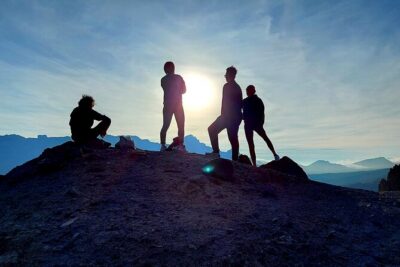
Teide by Night: Sunset & Stargazing with Telescopes Experience
Read our review →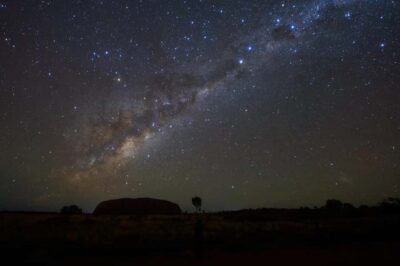
National Park Astronomy Tour with Telescope and Photo
Read our review →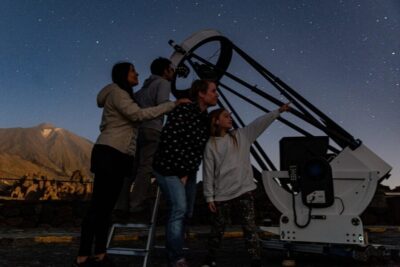
Teide National Park: Guided Large Telescope Stargazing Tour
Read our review →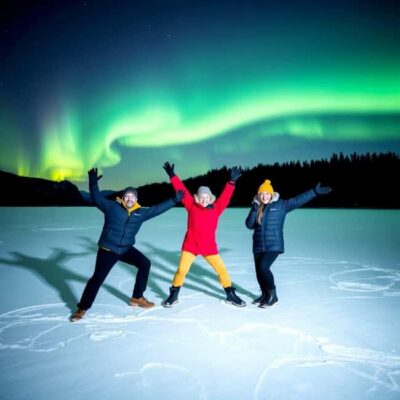
Northern Lights Tour and Stargazing by Telescope
Read our review →
Jasper Planetarium and Telescope Combo Tour Tickets
Read our review →
Cavalleria: Guided Stargazing at the Beach with Telescope
Read our review →
Twizel: Stargazing Tour with an Astronomer and Telescope
Read our review →Lists this night appears in