
REVIEW · NATIONAL PARK STARGAZING
Astro-Photo, Hiking and Stargazing Tour in Arches National Park
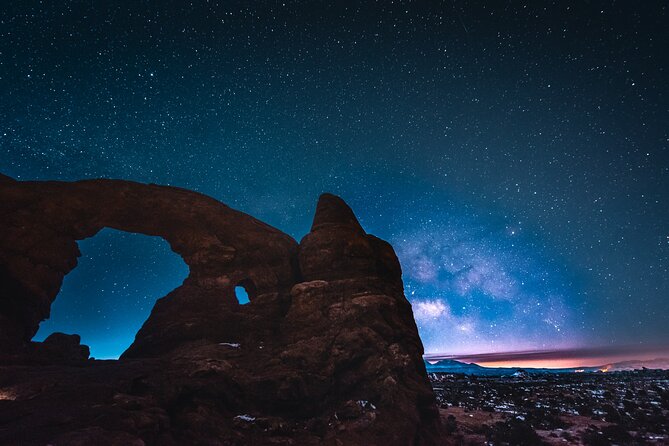
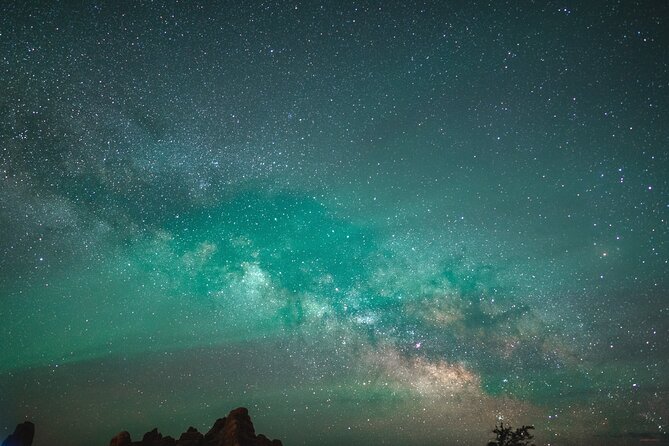
Arches National Park changes character after sunset. The red-rock arches become dark frames for the Milky Way, and the quiet trails feel far removed from Moab’s town lights. You’ll use provided tripods and headlamps while guides such as Brandon and Sam help turn a phone or camera into a night-sky tool.
I like the tiny group size, capped at six, and the practical instruction. I also like the chance to see Arches with no daytime crowds and cooler evening air. The main catch is the $175 price for about two hours, especially if you expect a telescope or transportation to the park.
Key points
- Milky Way views at the Windows Section: Photograph stars framed by some of Arches’ most dramatic rock formations.
- Small groups of six or fewer: You get more direct help with camera settings and composition.
- Phones are welcome: Guides can help you improve night photos even without an SLR camera.
- Tripods and headlamps are provided: This adds stability for photos and light for moving safely.
- Meet at the park, not in town: The Windows Section Parking Lot is the start and end point.
- Weather matters: Poor conditions can lead to a new date or a full refund.
Arches after dark, with the stars as your subject
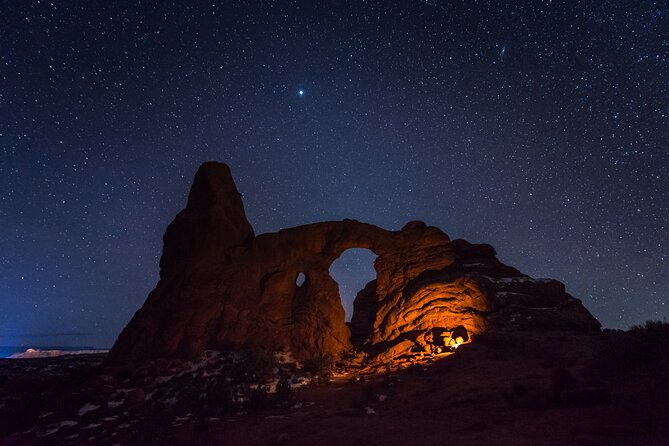
The best part of this outing is not simply seeing stars. It is learning how to photograph them in a place where the rock formations do half the artistic work.
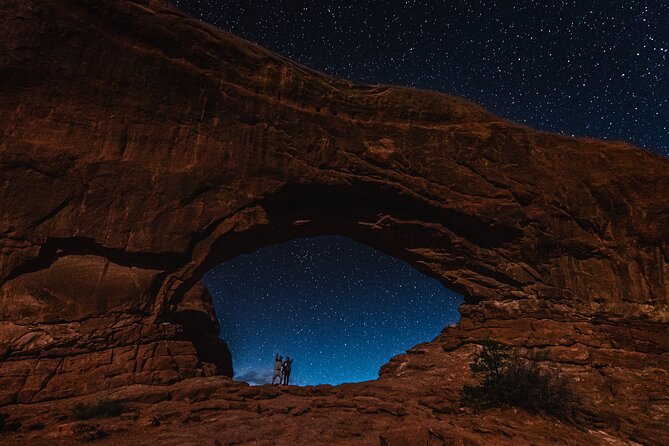
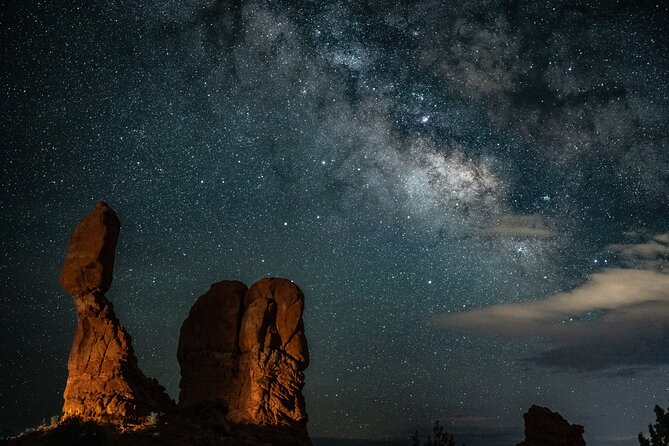
At the Windows Section, you are surrounded by the kind of stone that makes Arches famous: sculpted openings, red walls, and natural frames. At night, these formations recede into shadow while the sky takes over. A guide helps you place an arch or rock opening in the foreground, then aim your camera toward the constellations and Milky Way.
That changes the experience from ordinary stargazing into a small photography lesson. You are not just looking up and hoping for a good picture. You are learning where to place the camera, how to keep it steady, and how to make the stars show up clearly.
The tour lasts about two hours. That is enough time for a focused introduction, several photo setups, and a look at the night sky without turning the evening into a long, tiring outing. You return to the same parking lot where you began.
More National Park Stargazing in the USA
- Stargazing in Zion National Park’s International Dark Sky
★ 5.0 · 73 reviews - Private Stargazing – Sequoia National Park
★ 4.5 · 14 reviews - Milky Way Photography in Arches National Park
★ 4.0 · 4 reviews
Why the Windows Section works so well at night
The Windows Section is a smart meeting point because it puts you close to striking formations and trails. During the day, this area can feel busy and bright. After dark, the same rock garden takes on a quieter mood, with the crowds gone and the evening air cooler.
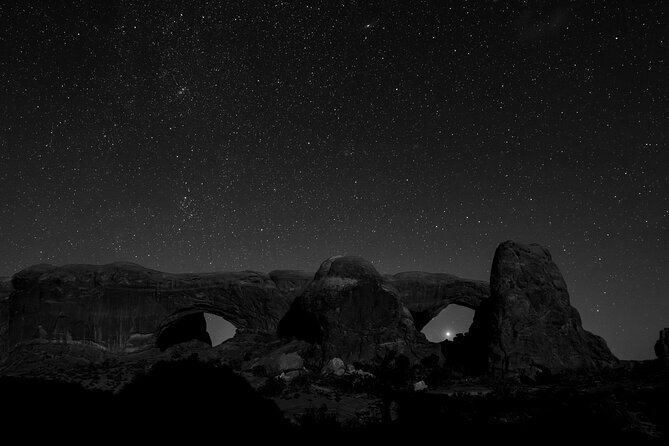
The tour description promises a route through the park’s arches, with time to consider how natural forces shaped them. At night, you will not study every detail of the rock in the same way you would under the sun. Instead, the shapes become silhouettes and picture frames.
That contrast is part of the appeal. You know the formations are there, but your attention shifts upward. A dark arch against a star-filled sky gives your photograph a clear sense of place. It also means you do not need a complicated composition. The park supplies one.
The walk is described as a two-hour park experience, not an all-day hike. Still, you should be prepared to walk outside in the dark and wear sensible shoes. Headlamps are provided for safety, but you will want clothing suited to changing evening temperatures.
What happens during the two-hour outing
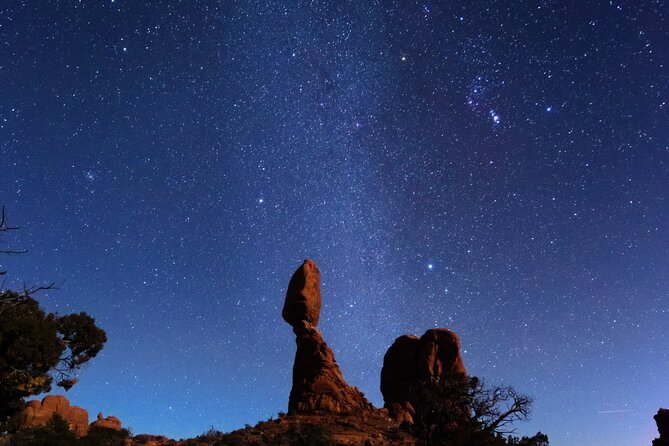
The evening begins at the Windows Section Parking Lot in Utah. This is both the starting and ending point, so you need to reach the park on your own and return to your vehicle afterward.
From there, the group moves through the nearby rock formations. The route combines a short nighttime hike with stops for stargazing and photography. The exact order of the stops can vary with the sky, the weather, and the guide’s chosen photo locations.
Expect the guide to point out arches and explain how they formed. The focus then shifts toward the sky, with attention to constellations and the Milky Way. You may spend part of the time simply looking up, then set up a camera or phone for a longer exposure.
The supplied tripods are important. Night photography usually requires the camera to stay still while it gathers light. A handheld phone photo may look dark or blurry, but a tripod gives you a much better chance of capturing stars and rock formations together.
Headlamps are useful for more than finding your way. They help you handle camera equipment, move between locations, and avoid fumbling in the dark. You should still use care on the trail, since a headlamp does not remove the need to watch your footing.
The guide’s role goes beyond pointing at stars
A good guide makes this experience work, and the strongest praise centers on the practical help provided by Brandon and Sam.
You can expect assistance with camera settings, phone settings, tripods, and photo composition. That matters because night photography can feel technical at first. You may know how to take a daytime picture but have no idea what to do when the subject is a dark arch and a sky full of faint stars.
The instruction is also adapted to the equipment you bring. You do not need an SLR camera to take part. One family used a phone and still learned how to make better night images, including a playful photo of a stuffed yellow-bellied marmot beneath the stars.
That detail tells you something useful about the tone of the outing. This is not only for serious photographers. Kids aged 12 and 14 were included in the activity, and the guide kept them involved by explaining constellations and helping them create their own pictures.
The guide also helps you understand what you are seeing. The experience is not limited to camera mechanics. You will hear about the stars, constellations, and the arches themselves, giving the evening more depth than a simple stop for photographs.
Same sky over the USA, a different way to watch it:
- Small Group Big Island Twilight Volcano and Stargazing Tour
★ 5.0 · 1,619 reviews - Griffith Observatory Hike: Guided Tour through Griffith Park
★ 5.0 · 1,020 reviews - Sedona Stargazing Tours LLC
★ 4.5 · 881 reviews - Miami: Frost Museum of Science and Planetarium Entry Ticket
★ 4.5 · 429 reviews
Phone cameras can produce worthwhile results
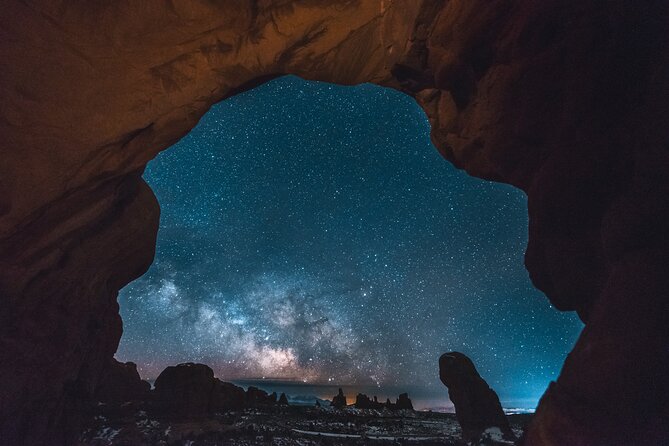
If you are carrying only a phone, do not assume you will be left out. The guide can show you how to adjust your phone for night photography and how to use the tripod for a steadier shot.
Your results will depend on the phone, the weather, and the darkness, but the instruction gives you a better chance than trying to work it out alone. A phone photo of the Milky Way may not match a professional camera image, yet it can still preserve the shape of the arch and the mood of the night.
This is one of the tour’s strongest points for casual photographers. You do not have to buy special equipment before arriving. The provided tripod covers the most basic need, and the guide can help you make sensible use of the camera you already own.
If you do bring a camera, you should be ready to follow instructions and make adjustments in low light. The guide’s help with settings is part of what you are paying for. This is not a photo stop where someone takes a picture for you and sends you on your way.
What the $175 price includes in practical terms
At $175 per person, this is not a cheap add-on to a Moab visit. The outing lasts about two hours, so the price works best for someone who values personal instruction, a small group, and a special nighttime setting.
The group limit of six is a real benefit. You are not standing behind a large crowd while one guide explains the same camera setting to everyone. With fewer people, you can ask for help with your own phone or camera, and the guide can spend more time finding a photo setup that suits your ability.
The supplied headlamps and tripods also add value. You do not need to arrive with all the basic gear, and you can focus on learning rather than carrying extra equipment.
Still, the cost may feel high if you mainly want to gaze at the stars. One important expectation to set: a telescope is not listed among the provided equipment. The activity centers on stargazing, constellations, and astrophotography, not on a formal telescope session.
Group discounts are available, though the specific savings are not provided. If you are booking for several people, check the final price carefully and compare the discount with the standard $175 rate.
Getting to the meeting point after sunset
The meeting point is the Windows Section Parking Lot, and the tour ends there. This arrangement keeps the outing simple once you arrive, but it puts the responsibility for getting to the park on you.
That can matter more than it sounds. The roads and surroundings are dark at night, and anyone arriving on the first evening of a Moab visit may find the drive challenging. You should plan your route before sunset and allow enough time to reach the parking lot without rushing.
There is no stated hotel pickup or transfer in the tour details. If you prefer an experience that collects you in town, this may not be the right fit. A transportation option would make the evening easier for some people, but you should assume you need to arrange your own arrival at the listed meeting point.
Because the same lot is used at the end, you will not need to coordinate a second pickup location. That is helpful when visibility is low and the roads are unfamiliar.
Weather can change the evening
This activity requires good weather. Clouds, poor visibility, or other bad conditions can interfere with both stargazing and photography, so the operator may cancel and offer another date or a full refund.
That policy is reasonable for a night-sky outing. A cloudy sky would remove the central feature of the experience, and a wet or unsafe trail would make the walk less pleasant.
You can also cancel for a full refund if you do so at least 24 hours before the start time. Changes or cancellations made less than 24 hours before the experience are not accepted, and the amount paid is not refunded. The cutoff uses local time.
For the best chance of a clear evening, keep your schedule flexible if possible. The sky is the main subject, and nature gets the final say.
Who will get the most from this experience
I would recommend this outing to several kinds of visitors:
- Casual photographers who want better night photos without taking a technical class.
- Phone users who want to learn what their camera can do after dark.
- Families with older children who can manage a short nighttime walk and enjoy constellations.
- Couples and small groups looking for a quieter Arches experience after the daytime crowds leave.
- National park visitors who want to see the park in a different light, literally.
It may be less suitable if you want a long, strenuous hike, a large astronomy presentation, or a telescope-based program. It is also not the best match if you dislike driving to a dark meeting point or consider $175 too much for a two-hour activity.
The tour is conducted in English. Most people can participate, but the available details do not provide a more specific accessibility assessment, so you should ask the operator about any individual mobility concerns before booking.
My final take on the night at Arches
This is a focused, personal experience rather than a broad tour of Arches National Park. You spend two hours near the Windows Section, learning to photograph stars and arches with direct help from a guide.
The strongest value comes from the combination of dark skies, a group of six or fewer, and hands-on camera help. Brandon and Sam are described as patient and engaging, and that matters if you arrive without much photography experience. The ability to use a phone also keeps the activity open to people who did not pack a full camera kit.
The price is the main question. At $175, you should book because you want instruction and a carefully planned night in the park, not simply because you want to look at stars. If you expect a telescope, hotel transport, or a longer hike, you may feel disappointed.
Book this tour if you want memorable Milky Way photos, a quiet Arches setting, and patient help with your equipment. Skip it if the cost outweighs the value of a two-hour outing or if you prefer to explore the park independently. For the right visitor, the chance to place a natural arch beneath the stars is worth planning around.
FAQ
Where does the Arches night tour begin?
The tour begins at the Windows Section Parking Lot in Arches National Park, Utah.
Where does the activity end?
The activity ends back at the Windows Section Parking Lot, the same place where it begins.
How long does the tour last?
The experience lasts approximately two hours.
How many people can join the tour?
The activity has a maximum of six travelers.
Are photography equipment and headlamps provided?
Headlamps and tripods are provided. The guides also help with phone and camera settings.
What happens if bad weather cancels the tour?
If poor weather causes a cancellation, you can receive a different date or a full refund. You can also cancel at least 24 hours before the start time for a full refund.
More Night Hikes in the USA
- Los Angeles: Griffith Observatory Guided Hike/Walking Tour
★ 4.9 · 199 reviews - Hollywood Sign Hiking Tour to Griffith Observatory
★ 4.9 · 106 reviews - Hollywood Sign Hiking Tour to Griffith Observatory
★ 5.0 · 99 reviews - Sedona Dark Sky Sunset & Night Hike With a Private Guide
★ 5.0 · 86 reviews
Fresh listings near the USA
- Boulder: Guided Astronomy Tour★ 4.7 · 11 reviews
- 1-Day Grand Canyon Tour from Las Vegas: Stargazing & Sunrise★ 3.6 · 3 reviews
- Milky Way Photography in Arches National Park★ 4.0 · 4 reviews
- Professional Stargazing in Moab★ 3.5 · 3 reviews
- Private Stargazing – Sequoia National Park★ 4.5 · 14 reviews
- Private Tour of Griffith Observatory★ 4.5 · 58 reviews
- Haleakala Sunset and Astronomy Tour★ 5.0 · 33 reviews
- Haleakala Sunset and Stargazing Audio Tour★ 4.0 · 10 reviews
National Park Stargazing, side by side.
Teide National Park Sunset & Stargazing with Dinner (Star Safari)
Read our review →
National Park Astronomy Tour with Telescope and Photo
Read our review →
Teide National Park: Guided Large Telescope Stargazing Tour
Read our review →
Self Drive Sunset & Stargazing in Teide National Park – No Dinner
Read our review →
Stargazing in Zion National Park’s International Dark Sky
Read our review →Lists this night appears in